
In brief: Avoid the five most common mistakes when applying iron fertilizer: incorrect timing in terms of weather and season, inaccurate dosage, uneven distribution, failing to water after application, and causing rust stains on paths or clothing. The right approach guarantees a healthy, moss-free lawn.
A lush green, dense lawn is the pride of every garden owner. Yet moss and faded colour often get in the way. Iron fertilizer is an effective solution. It creates a vibrant green colour and pushes back unwanted moss. However, applying it comes with pitfalls. Used incorrectly, it can lead to scorched grass, unsightly stains or rust on patio slabs. To help turn your lawn into the garden you have always wanted, we show you the five most common mistakes and how to avoid them.
Choosing the right product is the foundation for success. A high-quality, granulated fertilizer gives you a solid basis for simple and effective application. It is easy to dose and spread evenly.
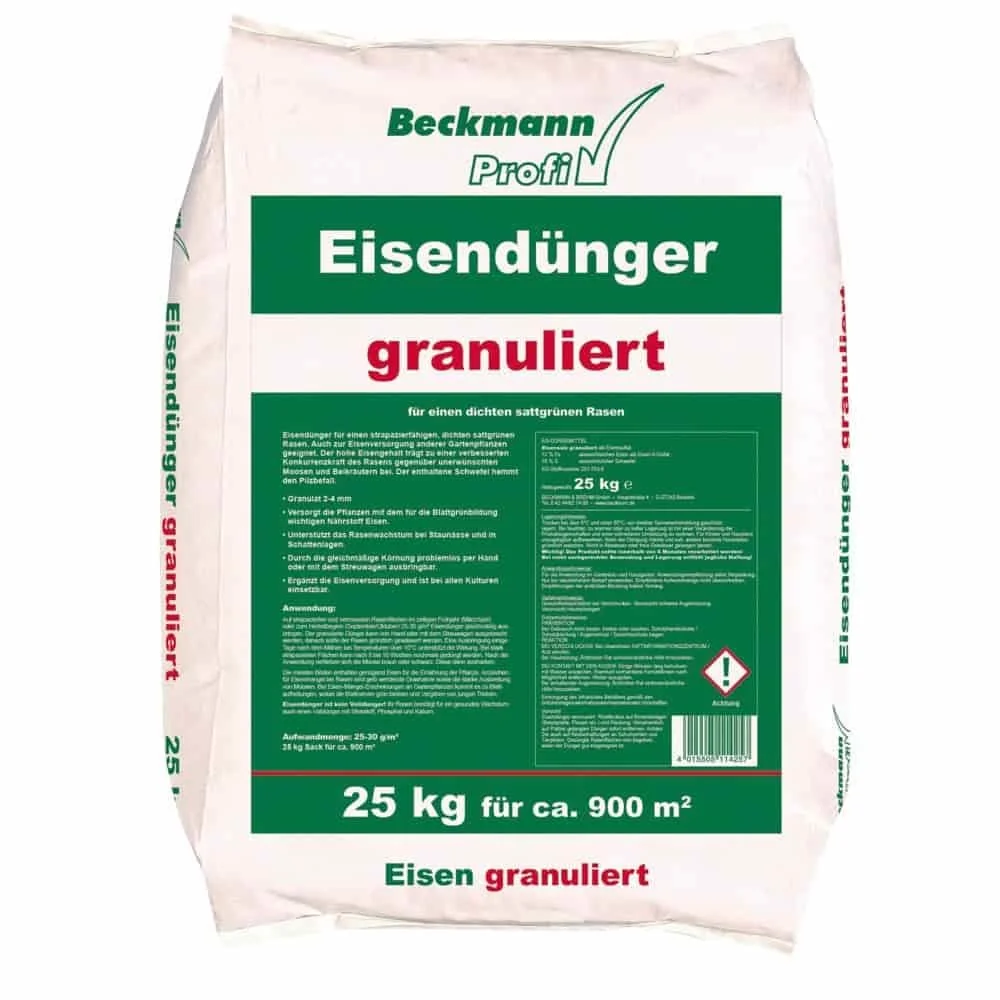
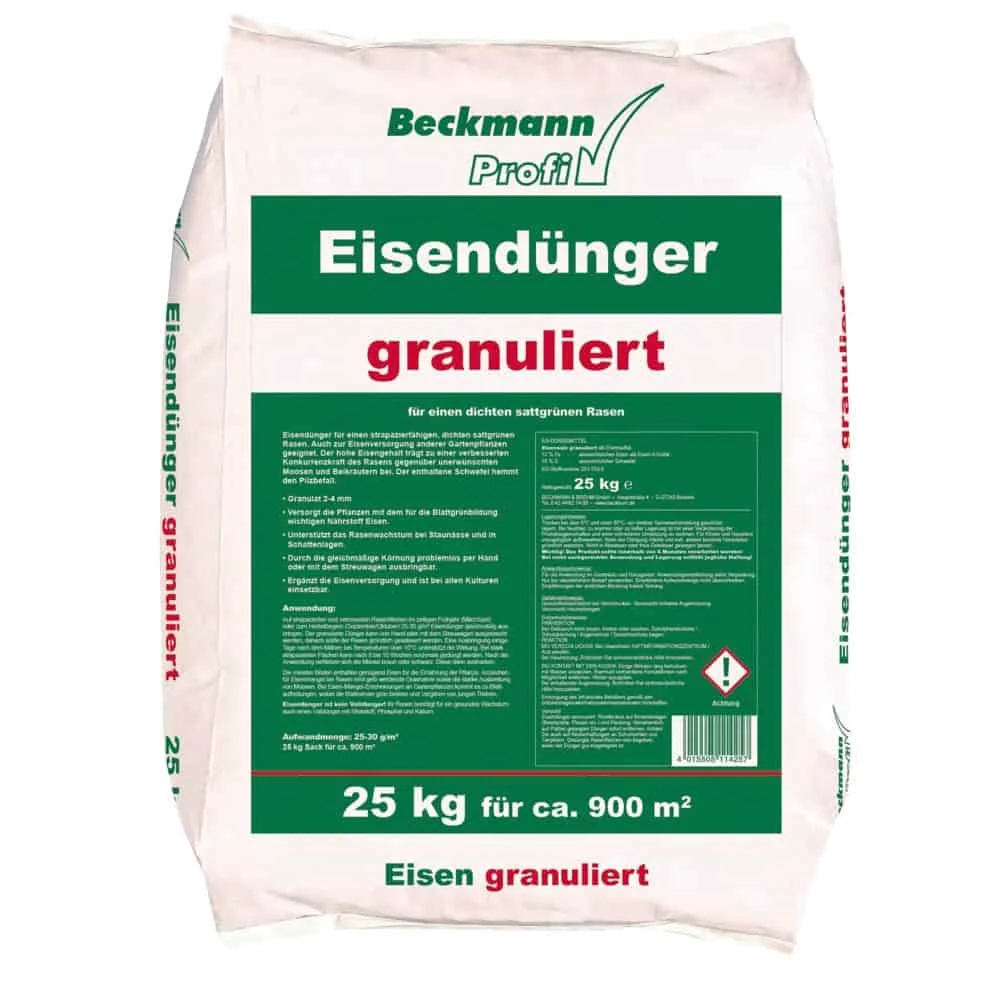
For an area of up to 900 m², the 25 kg granulated Beckmann iron fertilizer () is a good choice. Its fine 2-4 mm granules ensure excellent distribution and fast results. This gives your lawn an optimum supply of the important nutrient iron.
Contents
- Mistake 1: The wrong timing
- Mistake 2: The wrong dosage
- Mistake 3: Uneven application
- Mistake 4: Forgetting to water
- Mistake 5: Rust stains on paths and clothing
Mistake 1: The wrong timing – When is the best time to apply iron fertilizer?
Getting the timing right is crucial for iron fertilizer to work effectively. Many gardeners apply fertilizer by instinct, which often leads to less-than-ideal results. Iron fertilizer is not an all-year-round product, but a specialist for specific stages of the gardening year.
The ideal season for application
The main application period for iron fertilizer against moss is spring, typically from March to April. As soon as the soil temperature remains consistently above 10 °C, the lawn starts growing again. During this phase, it is particularly receptive to nutrients. A dose of iron gives it the kick-start it needs, supports photosynthesis and creates fast, vibrant green growth. At the same time, it effectively tackles the moss that grew over winter.
A second application in early autumn, in September or at the beginning of October, is also useful. It strengthens the lawn before winter, improves its resistance to frost and disease, and suppresses moss growth during the damp season. Avoid applying it in midsummer during extreme heat and drought. The lawn is under stress and could be scorched by the fertilizer.
Wait for the right weather
Choose a day with overcast skies and mild temperatures. Bright sunshine combined with fertilizer can scorch the grass blades. The soil should be slightly moist so that the granules do not simply remain on the dry surface. Ideally, apply the iron fertilizer a few days after light rain or after watering the lawn.
Heavy rain directly after application, however, is counterproductive. It washes the valuable fertilizer out of the soil before the roots can absorb it. It is worth checking the weather forecast for the next 24 to 48 hours. If heavy rain is expected, it is better to postpone fertilizing.
A healthy lawn starts with the right timing. Supplying your lawn with iron in spring and autumn gives it the strength it needs most at exactly the right time, helping to push back moss and start the next season in good health.
Mistake 2: The wrong dosage – How much iron fertilizer does my lawn really need?
“More is better” is one of the most dangerous misconceptions in lawn care. Overdosing with iron fertilizer can cause lasting damage to your lawn. Conversely, too little will not produce the desired result. Precision is key.
Risks of over- and under-dosing
Too much iron fertilizer causes the soil to become highly acidic. The pH level drops dramatically, blocking the uptake of other important nutrients such as phosphorus and potassium. The grass can become scorched, resulting in black, dead patches. These areas are slow to recover.
Too little fertilizer, on the other hand, has no effect. The moss is not controlled sufficiently and the greening effect fails to appear. You waste product and time without benefiting your lawn. The battle against moss and pale grass continues.
Calculate and weigh the correct amount
Always read the application instructions on the packaging. For most granulated iron fertilizers, the recommended application rate is around 25-30 grams per square metre. First, calculate the exact area of your lawn. Multiply the length by the width to determine the number of square metres.
Weigh the required amount for the entire area or for individual sections using kitchen scales. Do not rely on estimates made with cups or handfuls. This almost always leads to inaccuracies. A bag such as the lawn fertilizer with 25 kg also covers approx. 900 m² and is a good alternative when precise dosing is the priority.
Expert tip
Mentally divide your lawn into smaller, equal-sized sections of e.g. 10x10 metres (100 m²). Weigh out the exact amount of fertilizer for one section and spread it. This helps you develop a better feel for the correct amount and ensures even distribution across the entire area.
Mistake 3: Uneven application – How can I recognise application errors?
Even with perfect timing and precise dosing, the results can be disappointing if the fertiliser is not distributed evenly. A patchy lawn is often the direct result of careless application.
How to avoid a chequerboard pattern on your lawn
The typical sign of uneven distribution is an irregular colour pattern. Where too much fertiliser has landed, the lawn turns deep green or even black. Where too little has been applied, it remains pale and the moss survives. Sometimes stripes or patches appear, resembling a chequerboard. This uneven appearance spoils the look of the entire lawn.
Applying fertiliser by hand is the most common cause of this problem. It is almost impossible to distribute granules consistently by throwing them by hand. Even simple handheld spreaders without precise adjustment options can produce uneven results.
The solution: A lawn spreader
Invest in a good lawn spreader. It is the most important tool for even fertilisation. With a lawn spreader, you can set the application rate precisely and distribute the granules in uniform passes. The result is an even, consistently green lawn.
For optimum distribution, slightly overlap each pass. A tried-and-tested method is cross spreading: set the lawn spreader to half the recommended amount and cover the area once lengthways and once crossways. This minimises the risk of stripes and ensures perfect coverage. You can also find the right fertiliser accessories in the Westfalia range.
Mistake 4: Forgetting to water – Why do I need to water the lawn after fertilising?
The fertiliser is on the lawn and the job seems to be done. But one crucial step is still missing: watering. Without water, iron fertiliser cannot take effect and may even cause damage in the worst-case scenario.
Water as an activator and safeguard
Granular iron fertiliser must dissolve so that the grass roots can absorb the iron. Water transports the nutrient into the soil. If the granules remain on the dry blades of grass, they can cause scorching when exposed to sunlight. The high concentration of iron sulphate in one spot has a corrosive effect on plant tissue.
Thoroughly watering immediately after application washes the fertiliser granules off the leaves and dissolves them in the soil. The nutrients are then immediately available to the plant. The fast greening effect iron fertiliser is known for only occurs when this process runs smoothly.
Think of fertiliser granules as a concentrated power pack. Only water dissolves the nutrients and makes them available to the plant. Watering after fertilising is just as important as watering after planting.
How long and how thoroughly should I water?
Water the lawn thoroughly for about 15 to 20 minutes after fertilising. The soil should be moist to a depth of several centimetres. A lawn sprinkler is ideal for this and ensures even watering. Make sure no dry patches remain where the granules could be left behind.
If light rain is forecast for the next few hours, you can save yourself the effort. Gentle steady rain is the ideal partner for fertilising. During prolonged dry weather, continue to keep the lawn moist over the following days to maximise nutrient uptake.
Mistake 5: Rust stains on paths and clothing – How can I prevent discolouration?
Iron fertiliser is highly effective, but its chemical composition (iron-II sulphate) has an unpleasant side effect: when it comes into contact with moisture, the iron oxidises and produces stubborn rust stains. This mistake can be costly and take the pleasure out of having a green lawn.
Important note
Iron fertiliser granules cause permanent rust stains on concrete, paving stones, wood, clothing and shoes. Take great care when applying them and remove any spilled granules immediately and thoroughly before they come into contact with moisture.
Precautions when applying fertiliser
Care is the best protection against stains. Wear old clothes and sturdy shoes when working. Fill the lawn spreader on the grass, not on the patio or path. If any granules do spill, sweep or vacuum them up immediately. Do not rinse them away with water!
Make sure the granules do not land on adjacent paths, patio slabs or kerbstones. Modern lawn spreaders often have an edge guard that limits distribution to one side. Use this feature. As a precaution, cover sensitive surfaces near the edge of the lawn with a tarpaulin.
What should I do if something does happen?
If the mishap has already occurred and a granule has landed on a damp paving stone, you need to act quickly. On smooth, non-sensitive surfaces, you can try treating the fresh stain with a specialist rust stain remover. Always test the product on an inconspicuous area first. On porous natural stone, the stains are often almost impossible to remove.
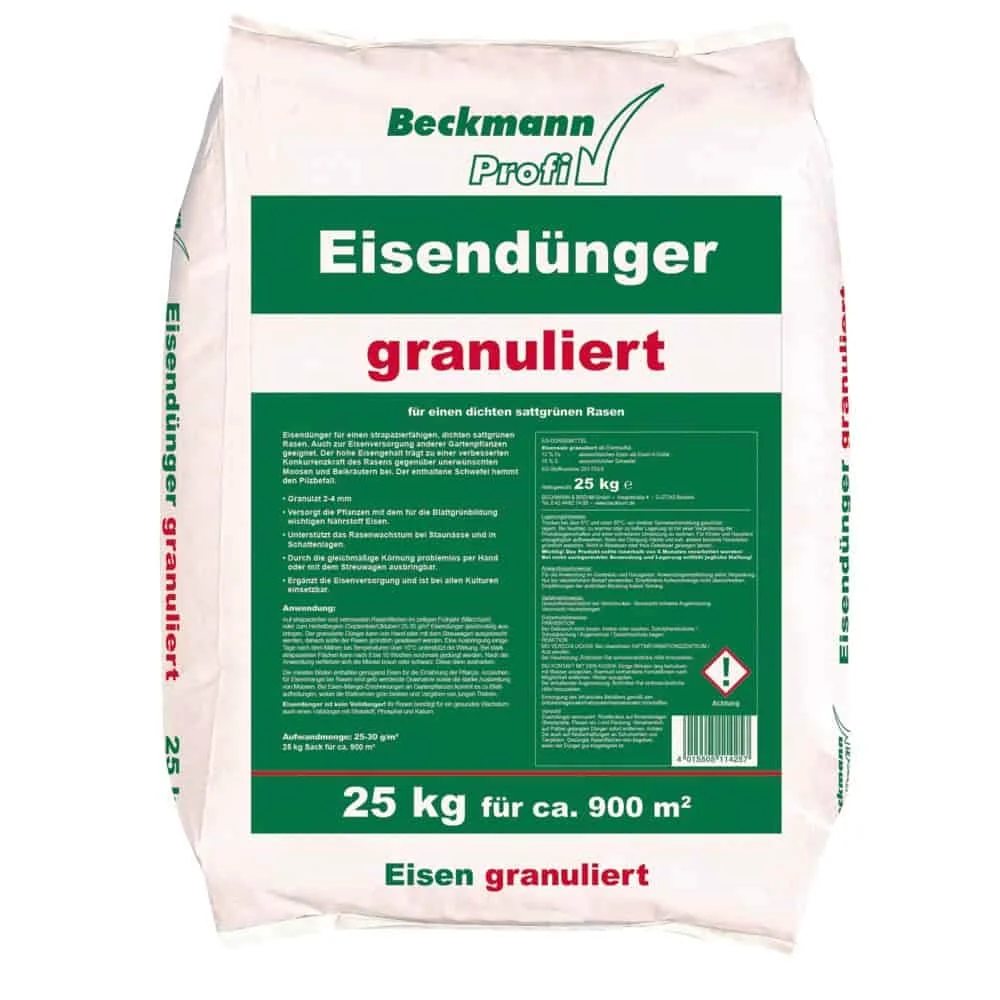
The quality of the fertiliser also plays a role here. A high-quality fertiliser such as Beckmann iron fertiliser () produces little dust, reducing the risk of it being blown onto unwanted surfaces. The uniform granule size also gives you better control when applying it with a lawn spreader.
Additional advice
Always store an opened bag of fertiliser in a dry place that is inaccessible to children and pets. Moisture in the bag causes clumping and makes even application impossible. A tightly sealed bucket provides optimum protection for the fertiliser.
A beautiful lawn is not the result of chance, but of targeted care. By avoiding these five common mistakes when applying iron fertiliser, you create the best conditions for dense, healthy and deep-green grass. The right timing, precise dosing, even distribution, watering afterwards and the necessary care make the difference between frustration and enjoyment in the garden. With quality products from Beckmann, you have the right partner at your side for lawn care.
Frequently asked questions
- When is the best time to apply iron fertiliser?
- Spring (March/April) and early autumn (September/October) are ideal. Apply it to damp grass, but not in direct sunlight or before heavy rain, to prevent it from being washed away. Temperatures above 10°C are optimal for best results.
- Can I use iron fertiliser and lime at the same time?
- No, you should avoid this. Lime raises the soil pH, while iron fertiliser works best in acidic conditions. Leave at least 6-8 weeks between applications to ensure both products work effectively.
- What happens if I use too much iron fertiliser?
- Overdosing can scorch the lawn and cause black patches. The soil becomes highly acidic, which inhibits grass growth and prevents the uptake of nutrients. Always follow the recommended application rate on the packaging.
- Why does my lawn turn black after applying iron fertiliser?
- Blackening, particularly of moss, is a normal and desirable reaction. Iron(II) sulphate kills the moss. After around one to two weeks, you can simply rake out or scarify the dead, black material.
- How can I remove rust stains from paving caused by iron fertiliser?
- Act quickly. For fresh stains, use a specialist rust remover or an acid-based cleaner containing oxalic acid. Always test cleaners on an inconspicuous area first. Careful application is the best way to prevent stains.
You may also be interested in
- How to use Beckmann iron fertiliser: Guide to a perfect 900m² lawn
- When to apply iron fertiliser: The best time to boost your lawn
- Buying iron fertiliser: What to look for in granulated fertiliser
- Green lawn: The 5 most common lawn fertilising mistakes
- Pelleted cow manure: The 5 most common garden mistakes
- Horse manure: Top 5 mistakes and how to avoid them