
In brief: A good wood moisture meter delivers accurate readings, is easy to use and suits your needs. For occasional DIY projects, a basic pin-type meter is often enough. Professionals in forestry need a rugged, calibratable model with long probes. Check the measuring range, accuracy and whether the meter is calibrated for your type of wood. Our comparison will help you choose.
Best Wood Moisture Meters: Test & Comparison 2026
Whether you are storing construction timber, restoring furniture or drying firewood, the moisture content of the wood matters. Wood that is too wet can shrink, crack or develop mold. A reliable wood moisture meter helps you check it with confidence. In our 2026 test and comparison, we explain the different measuring methods and what to look for when buying. Find the right meter for projects in agriculture, the trades or at home.
Table of contents
How do wood moisture meters work?
There are two main measuring methods: resistance and capacitance. Each has its advantages and drawbacks.
Resistance measurement with pin electrodes
This is the most common method. The meter has two metal pins that you press into the wood. A weak electric current flows between them. Because water conducts electricity and dry wood does not, the meter calculates the moisture content from the measured resistance. These meters are accurate, but the pins need to penetrate the wood.
Capacitance measurement without piercing the surface
These meters have a sensor that you place against the wood. They measure the material's dielectric constant, which changes with its moisture content. The advantage is that they do not damage the surface. However, readings are more affected by factors such as wood species and surface condition, and the meter often measures only to a shallow depth.
Tip: For most wood moisture measurements, pin-type meters are the best choice. They provide reliable readings when processing and drying wood.
What to look for when buying
Before choosing a model, check the following features to make sure it meets your needs.
Measuring range and accuracy: Check the stated measuring range. Good meters measure wood moisture from around 5 to 50 percent. Accuracy should be between +/- 0.5 and 1 percent. Budget models are often less accurate.
Wood species settings: These are essential. Different wood species need different calibration settings. Higher-quality meters offer correction values for 20 or more species, helping you avoid systematic measurement errors.
Controls and display: The display should be easy to read, even in bright light. An automatic shutoff helps extend battery life, and the menu should be easy to navigate.
Durability and accessories: For use in the woods or on a construction site, choose a rugged housing. Check whether the meter comes with replacement electrodes or a carrying case.
Compare the best wood moisture meters
There is a wide range of models on the market. We have compared different types and uses to help you find the right one. The table below gives a quick overview of the key details.
Top-rated wood moisture meters from our range, compared:
| Model | Customer rating | Availability |
|---|---|---|
| Euro-Netz Kombi Double-Point Electric Fence 150 m/2 - 50 Meter Roll for Agriculture | – | Currently unavailable |
| Fritz Göbel High-Pressure Hose 19mm Inner Diameter - Sold by the Meter | – | Currently unavailable |
| Fritz Göbel 300 Meter Lite Remote Trainer - Basic Obedience Training | – | Currently unavailable |
| Fritz Göbel Suction Hose 30mm Inner Diameter - Sold by the Meter | – | Currently unavailable |
| Fritz Göbel 600 Meter Lite Remote Trainer - Range up to 600 m | – | Currently unavailable |
For demanding measurements in professional settings, such as checking construction timber, a device like the
is a good choice. It offers high accuracy and an extensive wood species library.
For regular measurements in a workshop or sawmill, choose a rugged meter for everyday use. The
stands out for its simple operation and clear display.
If you need a meter for occasional firewood checks or DIY projects, the
is a reliable entry-level option. It delivers good results without complicated settings.
Warning: Never measure on a freshly sawn end grain or a wet surface, as this will skew the readings. Measure on undisturbed wood, ideally at several points and depths.
Practical Tips for Accurate Readings
Correct handling is crucial for accurate results. Work systematically.
Clean the electrode tips before every measurement. Grease or resin residue can distort the reading. Use a dry cloth or fine sandpaper.
Choose a representative measuring point. Avoid knots, cracks or discoloured areas. Measure in sound wood.
Set the correct wood species on the device. If you are unsure, use the oak setting. Note this value and the selected correction group for later comparisons.
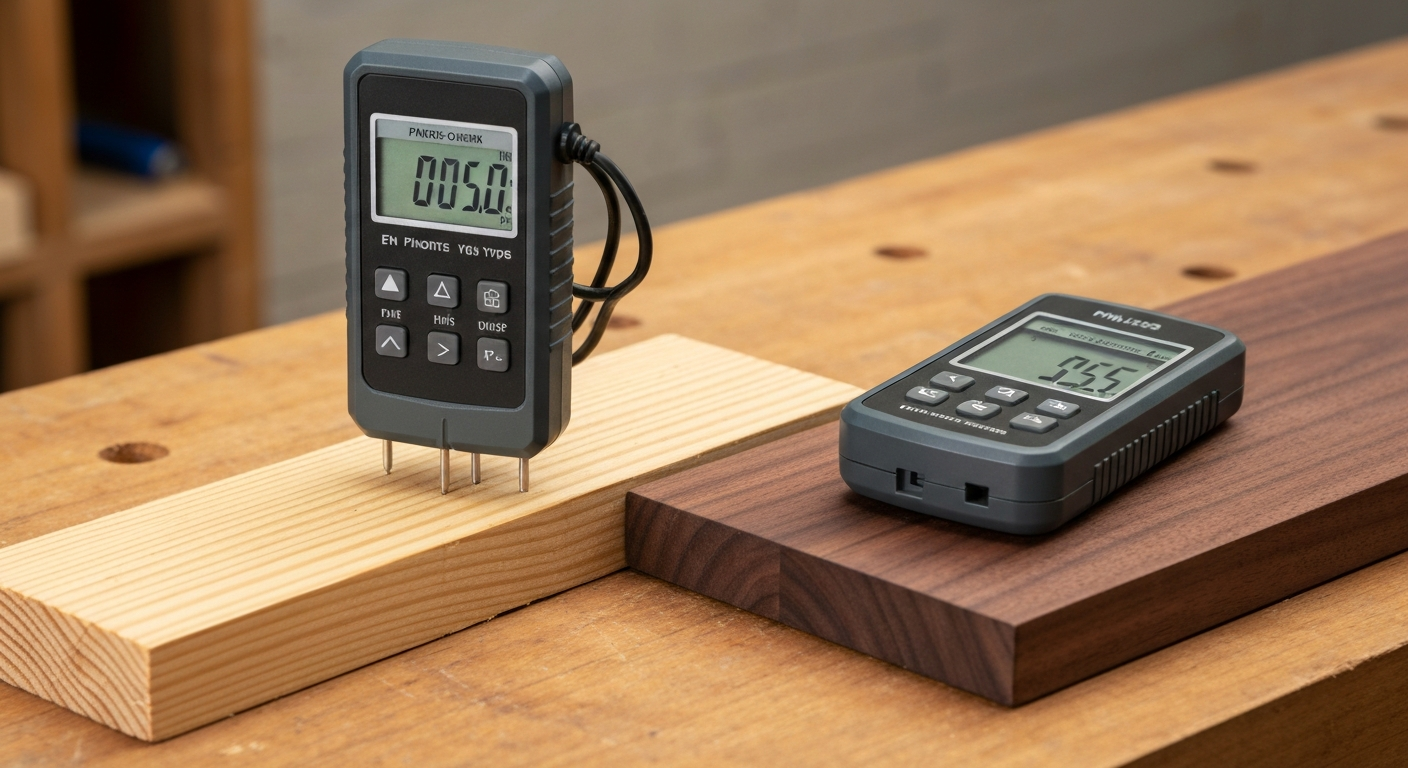
Press the electrodes deep and vertically into the wood. This allows you to measure moisture in the core, not just at the often drier surface. For thick beams, measuring from the side is recommended.
Common Measurement Errors and How to Avoid Them
Even with a good device, errors can occur. These are common causes.
Incorrect wood species setting: This is the most common error. A reading of 12 percent with the wrong setting could actually mean 8 or 16 percent. Check the wood species list in the instructions.
Surface measurement: The wood surface dries faster. Therefore, always measure deep enough. If necessary, use longer or depth-adjustable electrodes.
Wood temperature: Very cold wood can produce slightly different readings. Take measurements when the wood is at room temperature. Avoid measuring sun-exposed, hot surfaces.
Low battery: A weak battery leads to inaccurate readings. Replace the batteries regularly or recharge the battery before performance drops.
Note: No measuring device is completely error-free. For critical applications, such as accepting lumber, you should perform random checks with a second device or use the oven-dry method in a laboratory.
What Forestry Professionals Do Differently
Different standards apply in professional settings. The focus here is on efficiency and legal protection.
Professionals rely on calibratable devices. They have their measuring instruments adjusted at regular intervals by the manufacturer or a certified service. A calibration certificate documents the accuracy.
Documentation is key. Professional users record not only the moisture reading, but also the wood species, measuring point, date and device used. This data is important in warranty disputes.
Measurements are taken at several points. A single reading says little. Professionals take at least three measurements at different points on a board or beam and calculate the average.
The Future of Wood Moisture Measurement
The technology is continuing to evolve. Future devices will be even smarter and more connected.
We expect to see more devices with Bluetooth connectivity. This allows you to transfer readings directly to an app on your smartphone or tablet. The app can then manage wood species, save measurement series and create reports.
Artificial intelligence could simplify wood species recognition. The device could analyse the properties of the wood itself and suggest the appropriate correction group.
More robust, wireless sensors for capacitive measurement are becoming more accurate. This could make non-destructive measurements at greater depths possible, which would be particularly useful when restoring valuable wood.
Conclusion: Choosing the right wood moisture meter depends on how you plan to use it. For precise, reliable results in the trades and agriculture, resistance-type meters with wood species correction are hard to beat. Look for accuracy, ease of use and durability. With the models and tips presented here, you are sure to find the right device for your needs.
Frequently Asked Questions
- How does a wood moisture meter work?
- Most devices work on the resistance principle. They measure the electrical conductivity between two electrode tips that you insert into the wood. Dry wood conducts electricity poorly, while damp wood conducts it better. The measured conductivity is converted into a moisture reading and displayed.
- What moisture content is dry enough for lumber used in construction?
- For structural lumber used indoors, such as in roof structures or timber frames, a maximum moisture content of 15 to 18 percent is considered sufficiently dry. Furniture wood or parquet flooring requires readings below 10 percent. Freshly felled wood can contain more than 30 percent moisture.
- Can I insert the electrodes deep into the wood?
- Yes, for a meaningful measurement, the tips should penetrate the material deeply enough. This ensures that you measure not just the often drier surface, but the moisture in the core. Many professional devices allow you to select the insertion depth.
- Do I need a device with wood species correction?
- Absolutely. Different wood species have different densities and conductivity levels. You will only get an accurate result if you select the correct wood species on the device. High-quality models offer 20 or more correction groups.
- Can I use a measuring device to find hidden moisture?
- No, you need a capacitive moisture meter without probes for that. Resistance meters only measure at the points where the tips penetrate. Other types of devices are required for scanning large areas for leaks or rising damp.