
In brief: Choosing the best cordless spray gun primarily depends on how you plan to use it. Paint and varnish require high flow rates and fine atomisation. Compact systems are often sufficient for care products or disinfectants. Battery life, tank capacity and the viscosity of the liquids being sprayed are key factors. Our comparison highlights clear differences between DIY and professional models.
Cordless Spray Gun Test & Comparison 2026
Are you planning to paint something or looking for a reliable system for care and disinfection work? Cordless spray guns give you complete freedom without cables or hoses. Our 2026 test and comparison shows which models deliver on performance, handling and runtime. We help you find the right system for your projects.
Table of contents
What is a cordless spray gun?
A cordless spray gun is an electric handheld tool. It atomises liquids using an integrated pump and motor powered by a rechargeable battery. You need neither a separate compressor nor a mains power connection. This makes cordless spray guns ideal for work in the garden, workshop or on a building site.
The technology has advanced significantly. Modern lithium-ion batteries now provide enough power for demanding tasks. The devices differ in pressure generation, tank capacity and atomisation fineness. This means you can find the right tool for every job in our cordless spray guns category.
Buying criteria compared
Before making a purchase, you should understand the technical specifications. Not every model is suitable for every liquid. We compare the key factors.
Drive system and performance
The drive system is the heart of the tool. Powerful motors generate higher pressure. This is needed to atomise viscous liquids such as latex paint finely. Less powerful systems are sufficient for thin oils or disinfectants.
Pay attention to the stated working pressure or flow rate. Higher pressure generally means a more even spray pattern and fewer drips. A mid-range model is often sufficient for occasional DIY work. Professional users should choose a high-performance model.
Tip: Check whether the spray gun has an adjustable pressure setting. This lets you adapt the output to the liquid being sprayed and save battery capacity.
Battery technology and runtime
Battery runtime determines how long you can work without interruption. It depends on the battery capacity, usually stated in Ah, and the motor's power consumption. Lithium-ion batteries are now standard. They are lightweight, have no memory effect and provide consistent power.
Systems compatible with batteries from other tools on the same platform are particularly practical. This allows you to use existing batteries and extend operating time with spare batteries when needed. Charging time is another important factor.
Tank and flow rate
The tank may be mounted on top or designed as an integrated container. A larger capacity means fewer stops to refill. This is an advantage when covering large areas such as fences or facades. Smaller, more precise tanks are better for delicate work or when using expensive specialist products.
The pumping system is crucial. Most models use a piston or diaphragm pump. Check whether the pump is self-priming, as this makes starting easier. The materials used for the nozzle and valves must be chemically resistant to the liquids being sprayed.
Applications tested
A spray gun's suitability becomes clear in practical use. We tested the devices for typical applications.
Paint application and spraying
For paints and varnishes, fine and even atomisation is essential. It prevents runs and creates a smooth, seamless surface. Our test showed that high-performance models such as the demonstrate their strengths here. The 400 Watt output also atomises thick emulsion paint into a homogeneous spray mist.
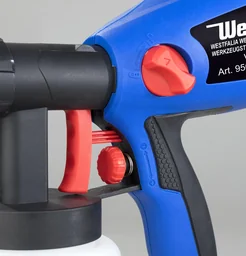
Adjustability of the nozzle is important. A conical spray pattern is ideal for large surfaces, while a pinpoint spray is better for details. Always test the setting on a sample area first.
Warning: Not all cordless spray guns are suitable for every type of paint. Highly viscous or fibrous materials can clog the pump and nozzle. Always follow the manufacturer's recommendations.
Care and protection
More compact systems are often sufficient for applying care oils, impregnating agents or corrosion protection. In these applications, ease of use and thorough coverage are the priorities. One example is the . It is lightweight and easy to handle, making it ideal for regular maintenance work on machinery, vehicles or garden furniture.
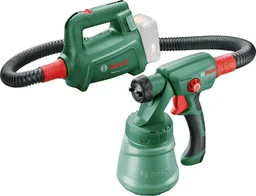
An extension hose can be useful for hard-to-reach areas. This lets you reach corners or undersides without having to hold the spray gun upside down.
Disinfection
Thorough disinfection is important in stables, warehouses or commercial kitchens. Spray guns designed to work with the relevant chemicals are used for this purpose. The devices must be resistant to aggressive substances and offer sufficient reach for efficient working.
Disinfection is a specialist application. Only use devices and accessories that the manufacturer has expressly approved for this purpose. The materials used for seals and valves are particularly important here.
Note: When spraying disinfectants or other chemicals, always follow the safety data sheets. Wear suitable protective clothing, especially respiratory protection and gloves.
The Best Models Compared
After extensive testing and hands-on evaluation, we recommend several models. The right choice depends largely on how you plan to use your cordless paint sprayer.
Here are the top-rated cordless spray guns in our range, compared side by side:
| Model | Customer rating | Availability |
|---|---|---|
| WFSP400 paint sprayer, 400 Watt | – | In stock |
| 18V cordless spray gun ASP18 including battery and charger | – | Currently unavailable |
| 18 V Li-Ion cordless spray gun ASP18 | – | Currently unavailable |
| Ballistol extension hose for spray - approx. 60 cm reach | – | Currently unavailable |
| Easy Spray 18V-100 cordless spraying system | – | Currently unavailable |
For powerful, versatile performance in DIY and professional applications, the (WFSP400 paint sprayer) is an excellent choice. This 400 Watt corded alternative delivers consistent performance with paints and lacquers. It is ideal for applying opaque coatings to large surfaces.
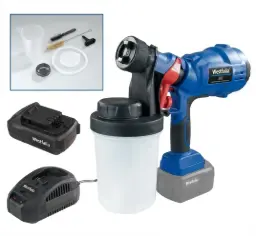
For maximum cordless freedom and convenience, the (Easy Spray 18V-100 cordless spraying system) is a great choice. It is part of an 18V platform and is lightweight and versatile enough for lacquers, care products and more. Its well-balanced design makes it easy to handle.
For a complete cordless solution that's ready to use, the (18V cordless spray gun ASP18 including battery and charger) is ready to use right out of the box. It's ideal if you don't yet have compatible batteries and want to get started right away.
Explore more options in our cordless tools range.
Handling and Maintenance
Even the best spray gun is hard to use if it feels awkward in your hands. Look for a well-balanced tool with an ergonomic handle. The trigger should move smoothly and give you precise control. A clear view of the tank's fill level is also useful.
Proper maintenance is key to a long service life. Clean the tool thoroughly as soon as you're finished using it. Use the cleaning agent recommended by the spray gun or paint manufacturer. Don't let paint dry in the tank or lines.
Store the cleaned spray gun in a dust-free place. Remove the battery if you won't be using the tool for an extended period. Check the seals and nozzle regularly for wear, and make sure replacement parts are readily available.
Conclusion and Buying Guide
Choosing the right cordless spray gun means weighing a few different factors. Start by defining your main application: do you need power for paint or a nimble tool for care products?
For demanding painting projects with emulsion paint or lacquer, choose a powerful model with high pressure and a large tank. Look for a nozzle that can be adjusted precisely.
For routine maintenance, applying impregnating products or spraying low-viscosity liquids, a compact, lightweight system should be enough. Battery life and ease of handling are key.
For professional use in agriculture or disinfection, choose a tool specifically labeled as chemical-resistant. Compatibility and safety come first.
Whichever model you choose, invest in quality. A good cordless spray gun can be a reliable helper for years. Browse our wide selection of tools to find the right accessories. With the right equipment, spraying jobs can be more efficient and more enjoyable.
Frequently Asked Questions
- What can you use a cordless spray gun for?
- Cordless spray guns are versatile tools. Depending on the model, you can use them with paints, lacquers, wood preservatives, care oils or disinfectants. Powerful systems are designed for opaque coatings, fine-atomizing models for lacquers, and lower-pressure models for thin liquids such as care sprays.
- How long does a cordless spray gun battery last?
- Runtime varies considerably depending on battery capacity, motor power and liquid viscosity. With continuous use at high power, expect around 20 to 60 minutes. Professional systems with interchangeable batteries can provide virtually unlimited runtime.
- Can you use any paint with a cordless spray gun?
- No. The spray gun must be designed for the paint's viscosity. Thin lacquers are usually no problem. Thick emulsion paints require specialized models with high pressure and possibly a built-in stirring function. Always check the manufacturer's specifications for material compatibility.
- What are the advantages of a cordless spray gun over a compressor spray gun?
- The main advantage is portability. Cordless spray guns are quiet, don't need a heavy compressor or a power outlet, and are quicker to set up. You can work without dealing with a hose. One possible drawback is lower, less consistent pressure when spraying very thick liquids.
- How do you clean a spray gun after use?
- Clean the spray gun immediately after use. Thoroughly flush the tank, feed system and nozzle system with the recommended solvent. Water is often enough for water-based paints. Dried residue can permanently block the fine channels and ruin the spray gun.
You may also be interested in
- Cordless Grinder Test & Comparison 2026: The Best Cordless Grinders
- Cordless Battery Test & Comparison 2026: The Best Models in Practical Testing
- Cordless Staple Gun Test & Comparison 2026
- Cordless Impact Drill Test & Comparison 2026
- Power Tool Test & Comparison 2026: The Best Tools Reviewed
- Hot Glue Gun Test & Comparison 2026