
In brief: In our forestry winch test 2026, we compare the most powerful models for professional use. We assess pulling power, safety, handling and compatibility with your tractor. A good forestry winch is characterised by robust construction, reliable brakes and a clear safety concept. Our buying guide helps you find the right model for your operational requirements.
A powerful forestry winch is essential for efficient and safe timber harvesting in the forest. It greatly expands the capabilities of your tractor and enables you to recover timber even in difficult or steep terrain. Our 2026 test and comparison examines the most important models in detail. We show you what to look for when buying and which winch suits your requirements.
Table of contents
What is a forestry winch?
A forestry winch is a device that can be mounted on a tractor and is powered via the PTO. It pulls felled tree trunks from the forest stand to the extraction route or storage area. This is done using a steel cable attached to the trunks. This protects the forest floor and reduces the use of machinery in sensitive woodland areas.
Modern winches offer high pulling forces, precisely controllable brakes and ergonomic controls. They are the backbone of soil-friendly and efficient forestry.
Test criteria
In our comparison, we assess the models according to specific criteria. These determine their practical suitability and cost-effectiveness.
Pulling power and performance
Pulling power, measured in kilonewtons (kN), is the key specification. It must match the maximum log volume and the terrain. A model that is too weak will overload both you and the tractor. An overly powerful winch is unnecessarily expensive. In our test, we check whether the stated force can be maintained during continuous operation.
Safety systems
Safety is non-negotiable. We look for a reliable, multi-stage braking system. A load brake holds the timber being pulled. A centrifugal brake prevents the cable from running out of control. The best models have an emergency brake that engages even if the hydraulic pressure drops.
Handling and comfort
Operation should be intuitive and require minimal effort. Long distances to attach and detach the load cost time and energy. Clear cable routing and a good view of the drum are essential. We test the ergonomics of the control levers in practical use.
Tip: Always allow for a performance reserve. If your typical load requires 35 kN, choose a model with at least 40-45 kN. This protects the machinery and increases safety.
Comparison of the best forestry winches
You will find models from various manufacturers and performance classes on the market. Our comparison highlights their respective strengths and ideal areas of use.
The highest-rated forestry products from our range compared directly:
| Model | Customer rating | Availability |
|---|---|---|
| Backpack frame, specially made for cases | – | Currently unavailable |
| Transport case with pre-formed recesses for PCW3000, 47 x 37 x 32 cm | – | Currently unavailable |
| Choker cable with steel rod, 10 mm x 2,1 m | – | Currently unavailable |
| Forstmarker Eco Neon Green 500ml - forestry marking paint | – | Currently unavailable |
| Forstmarker Eco Neon Yellow 500ml - forestry marking paint | – | Currently unavailable |
The table gives you an initial overview. The detailed assessment follows in the individual test categories. Pay particular attention to compatibility with your existing agricultural machinery.
Model for small woodland owners
Compact winches with a pulling power of 25-35 kN are suitable for managing woodland plots and harvesting firewood. They are light, easy to handle and suitable for smaller tractors. Their strengths are manoeuvrability and low fuel consumption.
Professional model for continuous operation
For forestry contractors or large businesses, heavy-duty winches from 50 kN upwards are the first choice. They work with long cables and high pulling forces in difficult terrain. Robustness, long maintenance intervals and high reliability are the priorities here.
Safety comes first
Every accident at work in the forest is one too many. The technology must therefore be fail-safe. In addition to the winch's built-in safety systems, responsibility also lies with you.
Check the cable for damage before every use. Inspect the mounting points on the tractor. Maintain the required safe distance from the operating winch and the tensioned cable. Never stand in the line of pull.
Warning: Never work alone with a forestry winch. A second person must be present as a spotter and in case of emergency. A breaking cable or a tree trunk thrown back can be life-threatening.
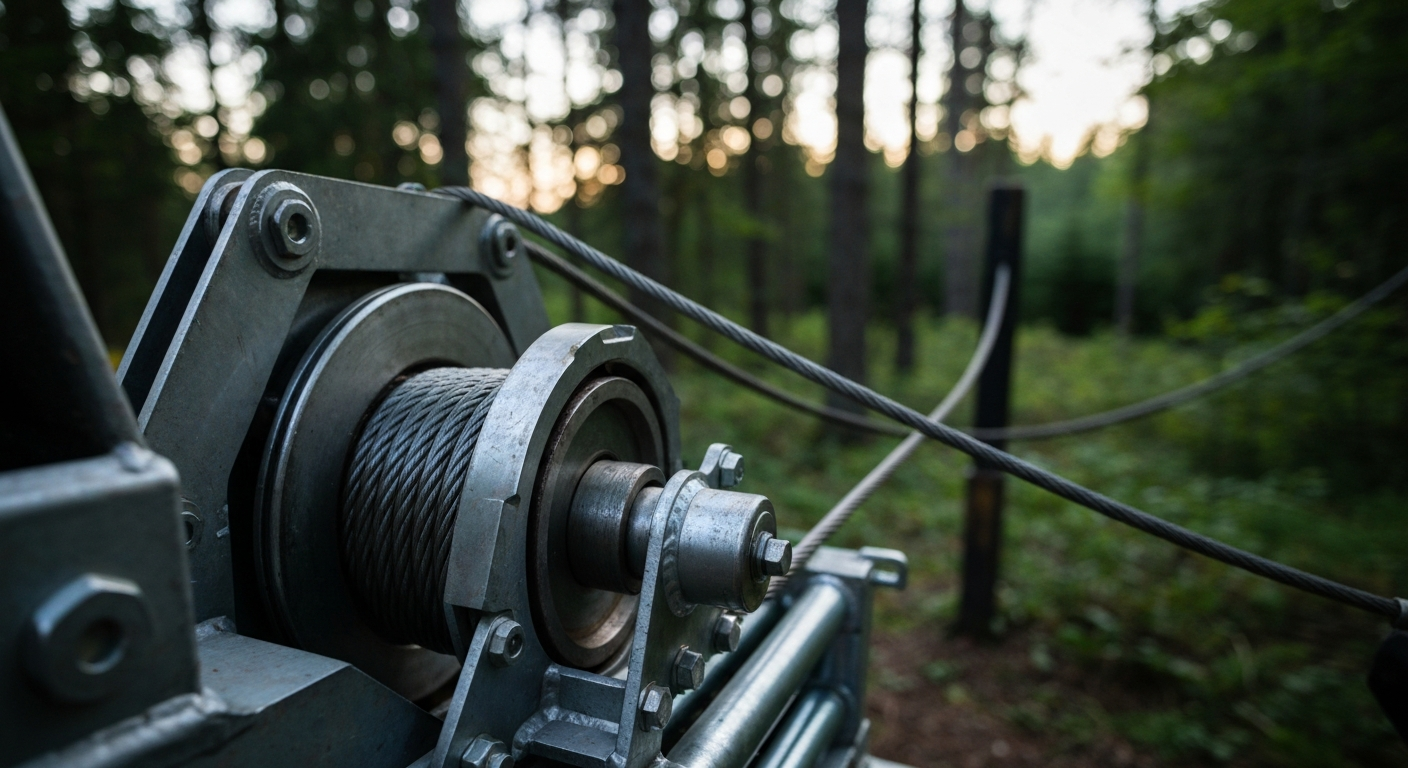
Correct cable routing
Correct cable routing prevents wear and increases safety. The cable must always be wound neatly onto the drum without overlapping. Use snatch blocks to avoid unfavourable pulling angles. This protects the cable and the winch mechanism.
Maintenance and care
Regular maintenance significantly extends the service life of your forestry winch. Schedule these tasks as a firm part of your routine.
- Daily: Visual inspection for damage, lubrication of moving parts and checking the cable routing.
- Weekly/Monthly: Inspection of pins and safety components, tightening of screws and checking the brake pads.
- Annually: Complete maintenance according to the manufacturer's specifications, replacement of wear parts and functional testing of all safety devices.
Note: Document all maintenance work. A maintenance log helps with troubleshooting and, in the event of damage, provides important evidence that the equipment was used as intended.
Accessories for professional use
The winch alone is not enough for timber harvesting. High-quality accessories are essential for a smooth workflow.
A robust choker cable is the connection between the winch and the timber. Our tested
with steel bar offers a high breaking load and easy handling. For a secure connection, you need reliable carabiners such as the with a breaking load of 50 kN.

Don't forget about organisation in the forest. Clearly mark extraction routes and trees to be felled. The
in neon green is clearly visible even in poor light and is environmentally friendly.
Storage and transport
Protect your investment when it is not in use. A dry, covered location helps prevent rust. Special transport cases or racks, such as those offered for other forestry equipment, are also worth considering for winch accessories.
Conclusion and buying recommendation
Choosing the right forestry winch is a long-term investment in the efficiency of your forestry operation. Base your decision primarily on the required pulling capacity and compatibility with your tractor. Operating convenience and the manufacturer's service offering are secondary, but still important.
Don't buy a winch that only just meets your requirements. The performance reserve is your safety margin. Choose high-quality accessories such as suitable cables and connectors from the outset. Only the combination of a powerful winch, safe working procedures and robust accessories makes timber harvesting productive and accident-free. Find out more about the different models from a specialist retailer in the forestry winch range.
Frequently Asked Questions
- What pulling capacity do I need for my forestry winch?
- The required pulling capacity depends on the maximum trunk diameter and the terrain. For medium-sized timber up to 40 cm on gentle slopes, 30-40 kN is often sufficient. For large timber or difficult terrain, 50 kN or more is recommended. Always allow for a safety margin.
- Can I attach any forestry winch to my tractor?
- No. You need to check compatibility with your tractor's three-point hitch (Category I, II or III) and PTO. Carefully check the required minimum power and mechanical connections before buying.
- How important is a cable brake on a forestry winch?
- A reliable cable brake is essential for safety. It keeps the load under control and prevents the cable from running out unintentionally. Integrated safety brakes that engage even in the event of a loss of pressure are an important quality feature.
- What is the difference between drum winches and plate winches?
- Drum winches wind the cable onto a drum, allowing it to be wound neatly. Plate winches lay the cable on a plate, making it quicker to change the cable. The right choice depends on your preferred working method and cable length.
- What accessories are essential for operating a forestry winch?
- Essential items include a robust choker cable such as PRODUCT_105549, reliable carabiners such as PRODUCT_99339 and suitable forestry marking products. Protective equipment such as a helmet, gloves and safety boots is mandatory.