
In brief: Apply Beckmann iron fertiliser to dry, freshly mown grass, ideally in mild weather. Use 25-30 g/m². Spread the granules evenly with a spreader. Water the area thoroughly after application to dissolve the granules, activate their effect and prevent scorching.
Contents
- How can I recognise iron deficiency in my lawn?
- Why is Beckmann iron fertiliser the right choice for 900m²?
- How do I apply Beckmann iron fertiliser correctly? The complete guide
- What happens after applying iron sulphate?
- Which mistakes should you avoid when applying it?
- Iron fertiliser in your annual lawn care plan
A lush, green and dense lawn is the pride of every garden owner. Yet yellow patches and unwanted moss often start to spread. The cause is frequently a lack of one essential nutrient: iron. Iron is vital for chlorophyll production and gives your lawn its deep green colour. Applying iron fertiliser correctly strengthens your grass, suppresses moss and creates a resilient lawn that can withstand heavy use.
For large lawns of up to 900 m², you need a product that offers good coverage and is easy to use. The : 25 kg granulated Beckmann iron fertiliser is designed precisely for this purpose. The fine granules can be spread evenly and provide fast, effective nutrition for your entire lawn.
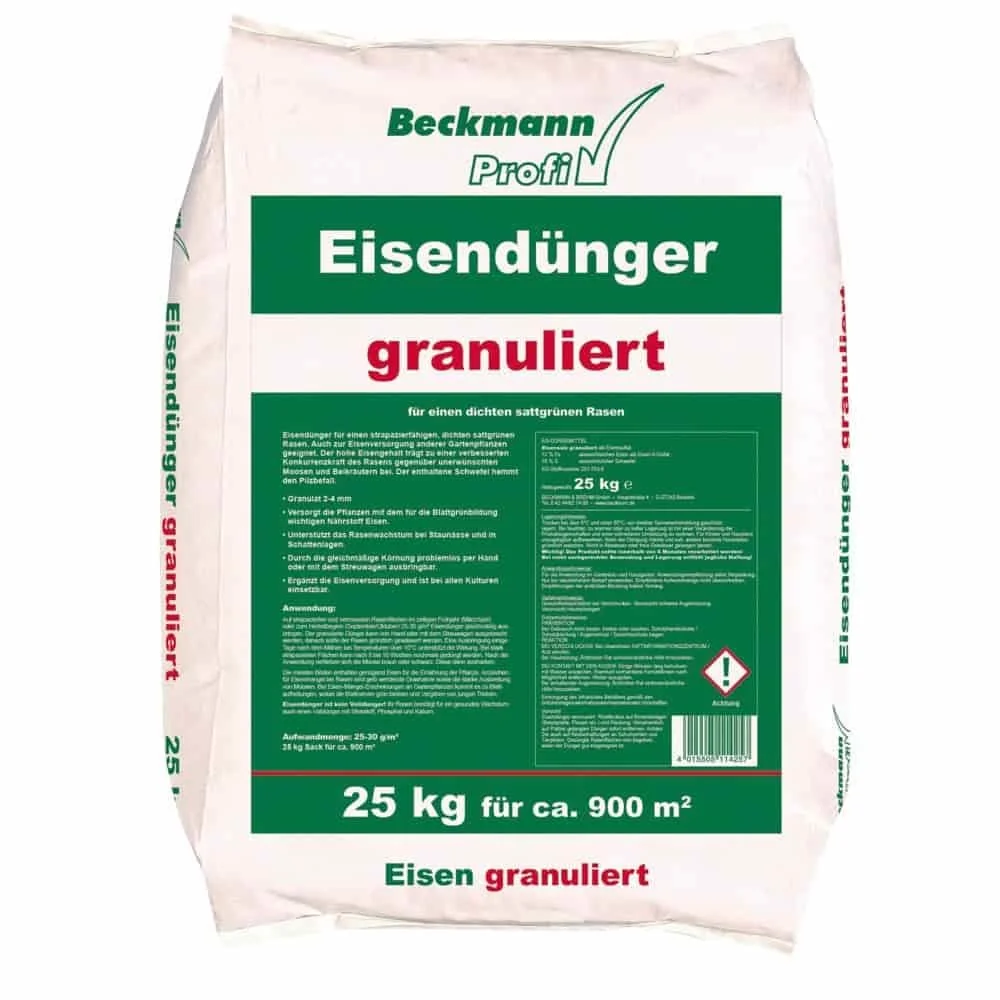
A healthy lawn starts with the right nutrient balance. Iron is the unsung hero responsible for the deep green colour and vitality of the grass. Targeted iron fertilisation in spring is the starting point for a perfect lawn-care season.
How can I recognise iron deficiency in my lawn?
Iron deficiency, also known as iron chlorosis, causes very specific symptoms. Look out for these signs so you can take action in good time. If you respond early, your lawn will quickly recover and return to a fresh green colour.
The most noticeable symptom is yellowing of the younger grass blades, while the older leaves often remain green. The leaf veins themselves usually stay darker green, which can give the blade a striped appearance. In cases of severe deficiency, the entire lawn turns pale green to yellow. The grass looks weak and grows only sparsely. At the same time, the weakened lawn provides ideal conditions for moss and weeds to spread. You can therefore identify iron deficiency through a combination of colour loss, poor growth and increasing moss infestation.
<>Why is Beckmann iron fertiliser the right choice for 900m²?
When dealing with a large lawn of 900m², efficiency and reliable results are essential. Beckmann iron fertiliser in the 25-kg pack is specially designed to meet these needs. The granular format, with a particle size of 2-4 mm, offers significant advantages over liquid alternatives or powders.
The granules produce little dust and can be distributed precisely and evenly with a spreader. This prevents over- or under-dosing in individual areas, which could result in uneven growth or even scorching. The granules also work directly at the grass roots, where they slowly penetrate the soil after watering. This allows the nutrients to be absorbed directly by the roots. One 25-kg bag covers the entire area of 900 m² with a single product – practical and cost-effective.
Additional advice
Store any opened bag of iron fertiliser in a cool, dry place. Moisture can cause the granules to clump together and affect their flow for the next application. A sealable plastic container is ideal for this purpose.
How do I apply Beckmann iron fertiliser correctly? The complete guide
Correct application is the key to success. Follow this step-by-step guide to get the most out of your iron fertiliser for moss and transform your lawn into a green oasis.
Step 1: Preparing the lawn
Start by preparing the area. Mow your lawn two to three days before fertilising to a height of around 3-4 cm. A shorter lawn ensures that the granules fall directly onto the soil instead of getting caught in the long blades. If your lawn is heavily thatched or has a lot of moss, now is the perfect time to scarify it. Scarifying removes thatch and moss while aerating the soil. The roots can then absorb nutrients and water more effectively.
Step 2: Choosing the right time
Choose a day with mild, overcast weather for application. Temperatures between 10 °C and 20 °C are ideal. Avoid direct sunlight and high temperatures, as these increase the risk of scorching. The lawn itself should be dry. Do not apply the fertiliser to grass that is covered in dew or wet from rain. The best time to apply iron fertiliser is in spring (March to May), to stimulate growth after winter, or in early autumn (September to October), to strengthen the lawn.
Step 3: Measuring the exact iron fertiliser dosage
Using the correct dosage is crucial. Too little will have hardly any effect, while too much can damage the lawn. For Beckmann iron fertiliser, the application rate is 25 to 30 grams per square metre. For your 900 m² area, you will therefore need the entire 25-kg bag. As a precaution, weigh out the amount needed for a smaller test area (e.g. 10 m² = 250 g) to get a feel for the volume and set your spreader correctly.
Important note
Iron fertiliser causes stubborn rust stains on concrete slabs, paving stones and clothing. Fill the spreader on the lawn and carefully sweep up any spilled granules immediately. Do not walk onto patios or paths with fertiliser residue on your shoes.
Step 4: Applying the fertiliser evenly
For an area of 900 m², a spreader is indispensable. It ensures fast and, above all, even distribution. Set the spreader according to the manufacturer's instructions for the desired application rate. First cover the area in lengthwise passes, then go over it in crosswise passes. This cross-spreading method ensures completely even coverage. Make sure the passes overlap slightly to avoid striping.
<>Pro tip
Halve the recommended amount of fertiliser per pass. Then cover the area once lengthwise and once crosswise (cross-spreading method). This gives you exceptionally even distribution and prevents unsightly overfertilised strips in the lawn.
Step 5: Watering after fertilising
This step is not optional; it is essential. Thoroughly water the entire lawn immediately after application for around 15 to 20 minutes. The water dissolves the granules and washes the nutrients from the grass blades into the soil and down to the roots. This not only activates the fertiliser but also reliably prevents leaf scorching. If no rain is forecast for the next 24 hours, watering is even more important.
What happens after fertilising with iron sulphate?
The iron fertiliser takes effect quickly. You will notice the first changes after just a few days. The iron contained in the fertiliser (as iron sulphate) works in two ways. Firstly, it is absorbed by the grass and stimulates chlorophyll production. The result: your lawn develops a visibly more intense, deep-green colour.
Secondly, iron sulphate has a caustic effect on moss. Moss plants cannot process the nutrient and die off. They turn black or brown within one to two weeks. You can then simply remove the dead moss from the lawn with a rake or by scarifying it again. The resulting gaps will quickly fill in on a healthy lawn or can be reseeded with grass seed if necessary.
Which mistakes should you avoid when applying it?
Although application is simple, there are some common mistakes that can affect the result. Avoid these pitfalls for the best possible outcome.
- Overdosing: "More is better" does not apply here. Too high a concentration will burn the grass roots and leave bare, brown patches. Strictly follow the recommended dosage of 25-30 g/m².
- Uneven distribution: Patchy application creates an unattractive "checkerboard pattern" of deep-green and pale-yellow zones. Always use a spreader for large areas.
- Applying to wet grass: The granules stick to damp blades and can cause scorching there. Wait until the lawn has dried completely.
- Forgetting to water: No water means no effect. The granules must be washed into the soil. If they remain on the leaves, they can cause damage when exposed to sunlight.
- Contact with paving slabs: Take great care not to spread granules on patios, paths or walls. The resulting rust stains are extremely difficult to remove.
Iron fertilizer in the annual lawn care plan
A single application of iron fertilizer is an important part of lawn care, but achieving a consistently perfect lawn requires a well-planned nutrient strategy throughout the year. Iron fertilizer is a specialist fertilizer and does not replace a complete lawn fertilizer containing the main nutrients nitrogen (N), phosphorus (P) and potassium (K).
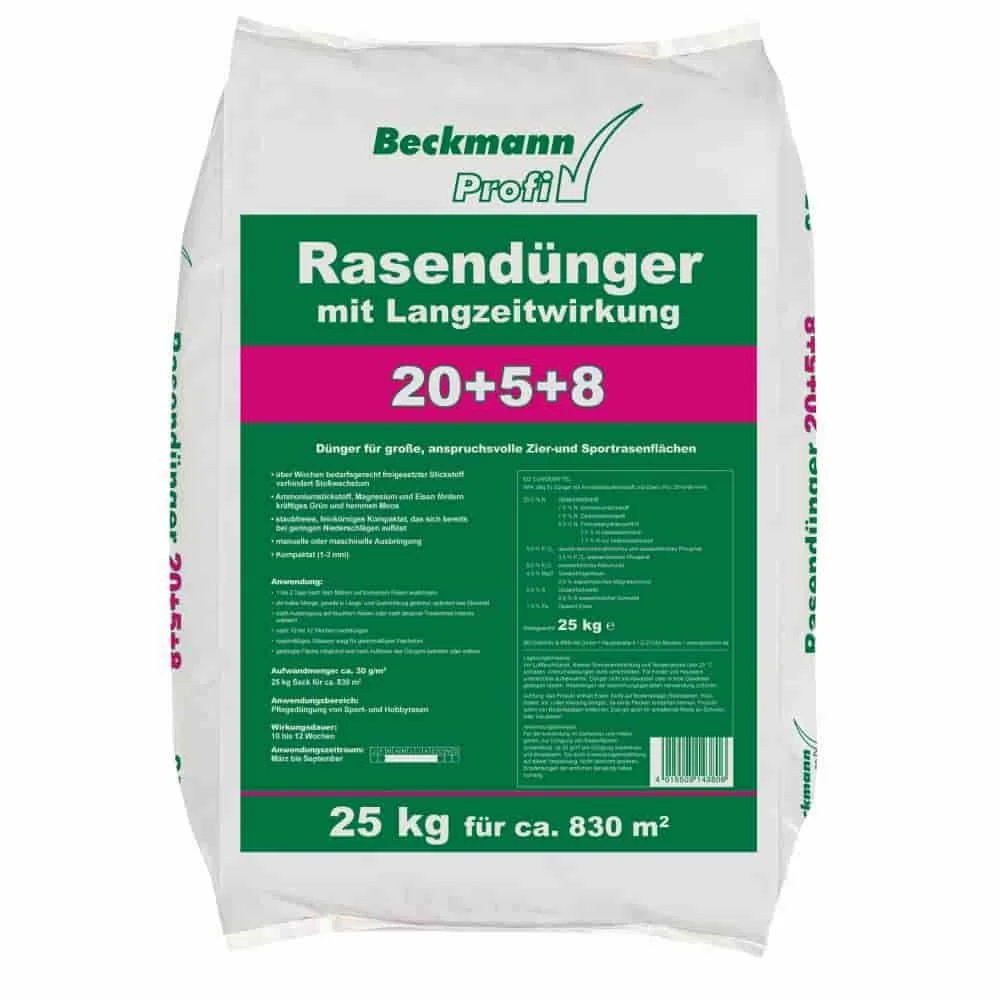
In spring, after applying the iron fertilizer, give your lawn the nutrients it needs for dense growth with a slow-release fertilizer such as : 25 kg slow-release lawn fertilizer 20+5+8 Beckmann. The high nitrogen content helps quickly fill the gaps left by the removed moss. In summer, the lawn can receive another application of this fertilizer as needed to help it withstand drought and heavy use.
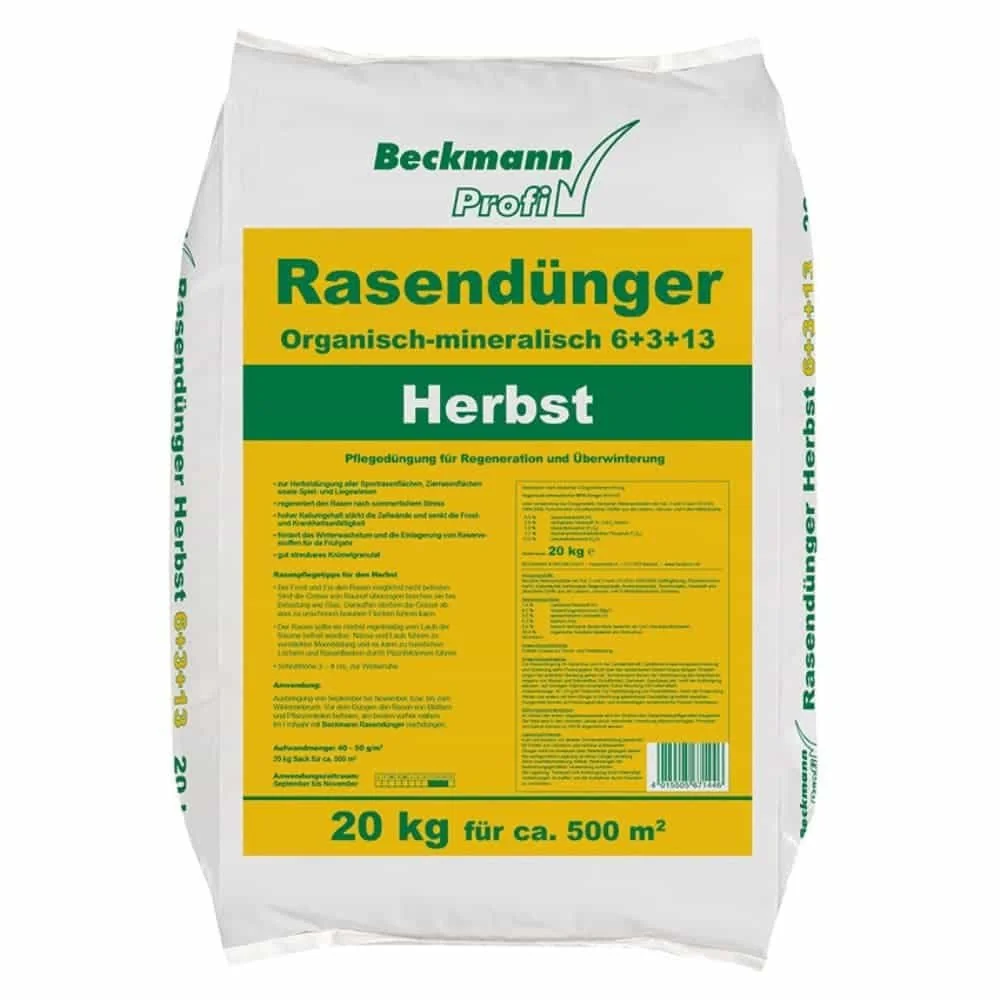
Autumn is the time to prepare your lawn for winter. A potassium-rich fertilizer such as : 20 kg autumn lawn fertilizer Beckmann NPK-6+3+13 strengthens the grasses' cell structure. This makes them more frost-resistant and less susceptible to winter diseases. A second, lighter application of iron fertilizer in September can also help eliminate the last moss before winter.
Think of lawn care as a cycle. Each season brings different requirements. If you start with iron in spring, support growth in summer and strengthen the lawn's defenses in autumn, you will be rewarded with a healthy lawn all year round.
Combining different fertilizers ensures that your lawn is optimally nourished at all times. Beckmann iron fertilizer is the specialist for intense green color and effective moss control, as part of a complete fertilization plan for your 900 m² outdoor oasis.
Frequently asked questions
- When is the best time to apply iron fertilizer?
- The ideal time is in spring (March/April) or early fall (September/October). Apply the fertilizer in mild, frost-free conditions. The lawn should be dry, but watering after application is essential to activate the nutrients.
- Can I apply iron fertilizer to a wet lawn?
- No, always apply iron fertilizer granules to a dry lawn. Otherwise, the granules will stick to the damp grass blades, which can cause scorching. Water only after distributing the granules evenly across the lawn.
- Why does the lawn turn black after applying iron fertilizer?
- It is not the lawn that turns black, but the moss. Iron fertilizer has a caustic effect on moss plants, causing them to die and turn black or brown. The grass, on the other hand, absorbs the iron and becomes stronger and greener.
- How long should I wait to mow after applying iron fertilizer?
- After applying the fertilizer and watering the lawn, wait at least three to four days before mowing again. This gives the grass enough time to absorb the nutrients fully and allows the fertilizer to take effect.
- Can iron fertilizer be dangerous for pets or children?
- Keep pets and children away from the treated area during and immediately after application. Once the granules have been thoroughly watered into the soil, the lawn is safe again for everyone in the family.
You might also be interested in
- Find the best lawn fertilizer
- Fertilizing your lawn: The right time for immediate results (NPK 21-6-12)
- How to fertilize your lawn properly in summer for a lush green color
- Promote lawn growth: Your path to a dense green lawn
- Green lawn: The 5 most common lawn fertilizing mistakes
- Lawn fertilizer with weed killer: An efficient combination for a flawless lawn