
In brief: The best ratchet wrench for you depends on how you plan to use it. For standard jobs, a reversible ratchet with a 3/8" drive and medium length is a solid all-rounder. Specialty tools such as telescoping ratchets offer extra reach, while universal sockets save you from changing tools. Pay attention to drive size, length, swing angle and build quality.
A good ratchet wrench is the centerpiece of many toolboxes. Whether you are repairing a car, assembling furniture or carrying out maintenance work around the house, the right ratchet wrench can make the difference between a frustrating struggle and efficient work. In our 2026 test and comparison, we show you which types and models perform well in practice. We help you make the best choice for your needs.
What types of ratchet wrenches are there?
Not all ratchet wrenches are the same. Choosing the right type is the first step toward efficient results.
Reversible ratchets – The all-rounder
The classic reversible ratchet is the most commonly used model. It has a lever that allows you to ratchet in two directions. This lets you tighten or loosen a screw without removing the tool. Quality is reflected in the swing angle and the durability of the mechanism.
Telescoping ratchets – For adjustable reach
Telescoping ratchets have an extendable handle. In the compact position, you can work in tight spaces. Fully extended, they provide significantly greater leverage and more torque for seized fasteners. A model such as the is a versatile helper.

Extension ratchets – For deep recesses
These specialty ratchets have a very long, slim head. They are designed to reach deep bores or recesses where a standard ratchet cannot. They are niche tools for special applications, such as industrial work.
Universal sockets – The space saver
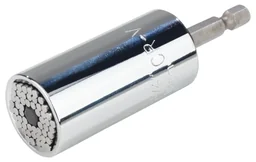
Universal sockets combine a ratchet with a bit holder. They accept standard hex bits, replacing an entire set of socket wrenches. This saves space and time when changing tools. Models such as the and the are good examples.
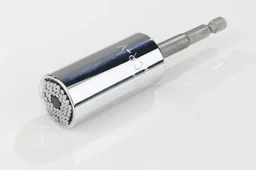
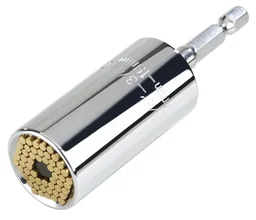
Tip: For your first toolbox, a reversible ratchet with a 3/8" drive and a length of around 180 mm is the best foundation. It reliably covers most everyday jobs.
What makes a good ratchet wrench? The buying criteria
When comparing models, pay attention to these technical details. They determine comfort, power and service life.
Drive size and shape
Drive size is fundamental. It is specified in inches (1/4", 3/8", 1/2", 3/4").
- 1/4" drive: For small, delicate jobs, electronics and low torque.
- 3/8" drive: The universal standard for assembly, bicycles, motorcycles and general repairs.
- 1/2" drive: For demanding work on cars, furniture and home construction. Our test model falls into this category.
- 3/4" drive and larger: For heavy-duty industrial and automotive applications.
The drive is usually a square fitting. Make sure it provides a clean, secure connection for the sockets.
Handle length
Handle length determines leverage and comfort.
- Short ratchets (approx. 100-150 mm): Ideal for tight spaces, but they provide less torque.
- Medium-length ratchets (approx.134 180-250 mm): The best compromise between ease of handling and power. The is a typical example.
- Long ratchets (over 250 mm): Generate high torque, but require more swing room.

Swing angle and ratcheting precision
The swing angle is a key criterion for precision. It indicates how far you need to move the handle before it reaches the next "click".
- A small swing angle (e.g. 5° or 10°) means many small steps. This is a major advantage in confined spaces.
- A large swing angle (e.g. 72°) means a robust but less precise mechanism.
The test showed that a fine swing angle noticeably improves efficiency in tight spaces.
Important: Never use a pipe as an extension on the ratchet handle. This overloads the ratcheting mechanism and can cause it to break. For extremely high torque, special torque multipliers or ratchets with a larger drive are available.
Material and workmanship
High-quality ratchets are made from chrome vanadium alloy steel (Cr-V). This material offers high hardness and toughness. The surface should be well chrome-plated to protect against corrosion. Look for clean workmanship without burrs and a comfortable, ergonomic handle.

Which ratchet is suitable for which application?
Practical use is what matters. Here are our recommendations based on typical applications.
General household and hobby tasks
For furniture assembly, small repairs and DIY projects, a reversible ratchet with a 3/8" drive and medium length is ideal. A fine ratchet angle is less important here. A solid basic ratchet from our ratchet range is perfectly adequate.
Vehicle repairs and maintenance
In the garage, you need several ratchets. A short 1/4" ratchet for intricate work in the interior, a robust 3/8" ratchet such as the for standard tasks and a long 1/2" ratchet for wheel nuts and stubborn bolts. A telescopic ratchet can be a practical problem-solver here.
Industrial / commercial use
Durability and reliability are the top priorities here. Choose professional models with a fine ratchet angle and high load capacity. Remember to consider spare parts and servicing. Regularly checking our tools category will keep you up to date with robust new products.
On the go and in emergencies
Space-saving universal sockets such as the or are perfect for an emergency kit in the car or your travel luggage. They replace a whole set of sockets and are lightweight.
Note: The availability of specialist models may vary. Always check the current stock status. Unavailable models such as some of the 2K reversible ratchets mentioned can often be replaced with similar alternatives.
Test results and direct product recommendations
Our comparison shows that there is no single "best ratchet". It depends on your needs. Here are our top recommendations from the test.
For universal use around the home and on vehicles, a medium-length 3/8" reversible ratchet with a good ratchet angle is hard to beat. It offers the best value for money.
Universal sockets are a convincing choice as a space-saving all-in-one solution. They are ideal for use on the go or as an addition to your existing tools. Models with a titanium insert often provide better grip.
For solving problems and achieving variable torque, a telescopic ratchet such as the is a smart investment. It saves you from having to buy several ratchets with fixed lengths.
For heavy-duty work and high torque, there is no getting around a solid 1/2" ratchet such as the . It is the tool for seized bolts and wheel nuts.
The highest-rated ratchets in our range compared directly:
| Model | Customer rating | Availability |
|---|---|---|
| Universal socket "Uni-Grip" 🏆 Test winner | ★ 4,9 (11) | In stock |
| Universal socket with titanium insert | ★ 4,7 (7) | In stock |
| Universal socket 1/2", 7 - 19 mm | – | In stock |
| 2K reversible ratchet 1/2 L.250 mm RSW5° | – | Currently unavailable |
| 2K reversible ratchet 1/4 L.150 mm RSW5° | – | Currently unavailable |
Care and maintenance of your ratchet
With proper care, a good ratchet can last a lifetime.
- Cleaning: Wipe off dirt and grease after use. Do not use aggressive solvents.
- Lubricating: Occasionally apply a drop of special ratchet oil or light machine oil to the ratchet mechanism. This keeps it running smoothly and flushes out fine particles of wear.
- Storage: Store your ratchet in a dry place protected from moisture. A toolbox or tool board is ideal.
- Checking: Regularly check that the ratchet mechanism operates without play and that the switching mechanism works perfectly.
Where can I find more information and tools?
Your search for the right ratchet starts here. Browse our extensive hand tools category to find suitable sockets, extensions and accessories. A complete project often requires more than just a ratchet.
Our 2026 test and comparison is designed to help you make an informed decision. Keep the key criteria of drive size, length and ratchet angle in mind. Choose the ratchet that suits your most frequent tasks. With the right model in your hand, every fastening job becomes easy.
Frequently asked questions
- Which ratchet drive size is right for me?
- The drive size (1/4", 3/8", 1/2", 3/4") determines the maximum torque transmission. Choose 1/4" for delicate work and electronics. The 3/8" drive is the universal standard for most assembly and repair tasks. 1/2" and larger are necessary for heavy-duty removal work and high torque in vehicle applications.
- What does the ratchet angle mean?
- The ratchet angle indicates how many degrees you need to move the ratchet before the mechanism engages again. A smaller angle (e.g. 5°) means more steps per revolution. This is an advantage in confined workspaces, where you can only move the handle a small amount. Larger angles (e.g. 72°) are robust but less precise.
- When is a telescopic ratchet worthwhile?
- A telescopic ratchet is ideal when you need variable handle lengths. Extended, it provides more torque for stubborn bolts. Retracted, you can work in confined spaces. This allows you to replace several ratchets with fixed lengths. Look for a stable locking mechanism and a joint without play in every position.
- Are universal sockets a good replacement for socket sets?
- Universal sockets can replace a basic set of sockets, but they are a compromise. They save space and time when changing sizes. However, their gripping force on fasteners is limited. For high torque or rusty bolts, conventional sockets with full engagement are often the safer choice.
- How can I recognise a high-quality ratchet?
- A high-quality ratchet has a precise, play-free mechanism with a fine ratchet angle. The handle feels comfortable in your hand, without sharp edges. The material is robust, often chrome-vanadium alloy steel. Look for a reliable switching mechanism and solid joint construction on telescopic models.
You may also be interested in
- Spanner Test & Comparison 2026: The best models reviewed
- File Test & Comparison 2026: The best models in practical use
- Multitool Test & Comparison 2026
- Pipe Wrench Test & Comparison 2026
- Combination Pliers Test & Comparison 2026: The best models reviewed
- Workshop Test & Comparison 2026: The best tools in practical use