
In brief: The three metal contacts in a grounded outlet (Schuko) have clear safety functions. The upper and lower contacts are live and neutral – they carry electricity to the appliance. The contact on the side is the protective conductor (PE). It disconnects dangerous voltage in the event of a fault by diverting the current. This grounding prevents potentially fatal electric shocks.
What Do the Metal Pins in an Electrical Outlet Mean?
You plug in the connector. Two pins slide into the holes. A third contact engages on the side. These three metal components form a safety system. It protects you from electric shocks and your home from fire.
We explain the role of the live, neutral and protective conductors. You will understand why grounding is vital. We also show what to look for in power strips and adapters.
Contents
How does electricity flow through an outlet?
Electricity needs a closed circuit. It flows from the power station to the appliance and back again. In a home outlet, two contacts perform this task.
The live conductor (L, often black or brown) carries the electrical current under voltage. The neutral conductor (N, blue) provides the return path to the power source. Both are responsible for operating the appliance.
The third contact, the protective conductor (PE, green-yellow), is not energized during normal operation. It only steps in if a fault occurs. This system is known as a grounded outlet, or Schuko.
The role of voltage and potential
Voltage is the driving force behind current. It exists between the live and neutral conductors, typically at 230 Volt. The neutral conductor is approximately at earth potential. This means its voltage relative to the ground is almost zero.
The protective conductor is directly connected to the earth. It therefore always has the same potential as the ground beneath your feet. This physical principle is at the heart of electrical safety.
Pro tip
Always verify that the power is off before starting work. Switch off the power for the affected circuit at the electrical panel. Use a two-pole voltage tester to check that no voltage is actually present. A simple one-pole voltage tester ("voltage pen") is not sufficient.
For all electrical work in the home and garden, you will find suitable tools and materials in our workshop and supplies category.
Why is the metal contact on the side so important?
The protective conductor is your safety net. Imagine that the insulation in a hair dryer comes loose. The live conductor touches the metal casing. Without a protective conductor, the casing would be at 230 Volt.
If you touch it, your body becomes part of the circuit. The current seeks a path to earth. It flows through your hand, your body and your feet into the ground. This can be fatal.
With a functioning protective conductor, something else happens. The fault current immediately flows away through the green-yellow wire. This path has very low resistance.
How does the circuit breaker trip?
The sudden current flow through the protective conductor is a short circuit. The current rapidly rises. The fuse or circuit breaker (MCB) in the electrical panel detects this overload.
Within a fraction of a second, it interrupts the circuit. The voltage at the casing collapses. You are protected before you even touch the hair dryer.
Modern installations also have a residual-current device (RCD). It compares the current flowing in and out. If a small amount is diverted (from 30 mA), it detects a possible fault current through the body. The RCD switches off in under 0.2 seconds.
“The protective conductor consistently applies the principle of directing dangerous fault currents along the path of least resistance – away from people. It is not optional, but a structural necessity for all Class I appliances.”
Appliances with metal casings, such as kettles, washing machines and garden tools, need this protection. Always make sure the plug is complete.
What types of outdoor outlets are available for the garden?
Different rules apply outdoors. Moisture and dirt increase the risk. Garden outlets must have special protection.
Permanent outdoor outlets have a hinged cover and are splash-proof (at least IP44). They are connected by an electrician. Portable solutions include special outdoor power strips.
These power strips have a robust housing and sealed socket openings. You can identify them by their IP rating. IP44 protects against splashing water from all directions.
Important note
Never use standard household power strips outdoors. Rain or sprinkler systems can cause short circuits and electric shocks. Only power strips explicitly marked for outdoor use (IP44 or higher) are safe. The circuit should also be protected by a residual-current device.
For permanent installation in a garden shed or on a patio, a robust outlet such as our
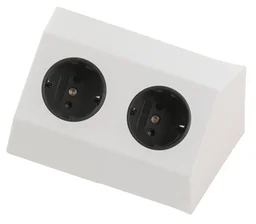
Find everything for outdoor use in our Garden + Outdoor category. It also includes suitable garden tools with electrical connections.
Outlets for the workshop and grilling area
Heavy-duty CEE outlets for three-phase power have five contacts. They supply powerful equipment such as welding inverters and large saws. They are less common in gardens.
At a grilling area or fire pit, outlets are useful for lighting or rotisserie spits. Make sure there is sufficient distance from heat and open flames. Use heat-resistant cables.
For projects like these, it is worth browsing Grills + Fire Pits.
How can I identify a safe power strip?
Not all power strips are the same. Cheap products without safety certification pose risks. They can overheat or fail to provide reliable contact.
Look for recognised safety marks such as GS (Geprüfte Sicherheit) or the VDE mark. These confirm that the product complies with German safety standards. The maximum load in amperes (usually 16 A) must be stated on the rating plate.
A good power strip has surge protection. It protects connected electronics from lightning strikes on the power grid. A separate power switch improves operating safety.
Our
, the 10-way aluminium power strip, combines these features. It offers surge protection, a switch and a durable aluminium construction.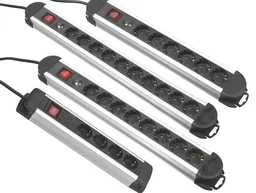
Additional advice
Calculate the total load of your connected devices. Add up the wattage. Divide the total by 230 volts (mains voltage). The result is the current in amperes. If it remains above the power strip's rated load (e.g. 16A), it will overheat. It is better to distribute devices across several circuits.
The dangers of multi-plug adapters and power strips
Outlet adapters turn one outlet into several. They pose two risks. First: mechanical strain. The leverage increases, causing the plug to loosen in the wall outlet.
Second: overloading. You plug several devices into a single outlet designed for only 16 A. An adapter such as
is practical for USB devices. However, do not use it to charge high-power devices.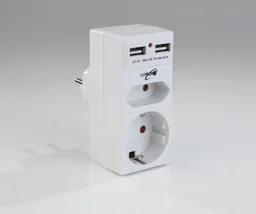
Do not connect one power strip to another ("daisy-chaining"). This overloads the first power strip and the wiring in the wall. It creates a fire hazard.
„More than 30% of electrical fires in homes are caused by overloaded or defective power strips and multi-plug adapters. The maximum continuous load is often ignored. A 16-amp power strip is not a licence for continuous operation at 3500 watts.“
Which mistakes compromise outlet safety?
Visible damage is a warning sign. Discolouration, black scorch marks or melted plastic indicate overheating. A sharp burning smell (ozonised plastic) confirms it.
Loose outlets where the plug droops are dangerous. The contact is inadequate. Contact resistance develops, generating intense heat. Have such outlets replaced by an electrician immediately.
Outlets near water sources such as sinks or in unheated garden sheds need special protection. Moisture conducts electricity. Outlets with RCD protection in the circuit are mandatory here.
Incorrect handling of cables
Kinks in the power cable damage the insulation. Do not run cables under carpets or door thresholds. The pressure gradually damages the conductors.
Never pull on the cable to unplug it. This damages the connection between the cable and the plug. Always grip the plug body directly.
For regular care of your outlets, we recommend
, the 2-in-1 outlet cleaning brush. It safely removes dust from the contacts.
Find more safety products for your home and workshop under Occupational Safety & Security.
How should outlets be maintained?
Maintenance begins with a visual inspection. Check all outlets in your home twice a year. Look for the signs of damage mentioned above. Check that the outlet cover is firmly attached.
Clean the contact openings. In rare cases, dust and lint can cause leakage currents or scorch. Use a non-conductive brush with the circuit switched off.
Test operational safety. A simple outlet tester costing just a few dollars shows whether the live, neutral and ground wires are connected correctly. It detects reversed connections and a missing ground wire.
When should you call a professional?
All work behind the outlet cover is electrical work. Tightening loose terminals, replacing the outlet or extending cables may only be carried out by a licensed electrician.
This also applies to installing new outlets in the garden or in damp rooms. A professional knows and applies the current VDE regulations.
They document their work and issue a declaration of conformity. This gives you legal protection. In rented homes, always inform your landlord.
The three metal contacts in your outlet work as a team. The live and neutral wires deliver the power. The ground wire protects your safety. Respect this system.
Use only tested products. Avoid overloading. Hire professionals for installations. This is how you can effectively protect your home and family from the dangers of electricity.
Frequently asked questions
- What happens if the protective earth conductor in the socket is faulty?
- A faulty protective earth conductor (PE) removes the most important safety function. If an insulation fault occurs in the appliance, its metal casing may become live. If you touch it, the circuit is completed through your body to earth. This can cause a life-threatening electric shock because the fuse will not trip. Check sockets regularly or consult a qualified electrician.
- Can I operate an appliance without an earth pin in a Schuko socket?
- Yes, with an adapter. However, this is risky. The adapter disconnects the protective function, leaving the appliance with basic insulation only. If a fault occurs, there is an increased risk of electric shock. Only use such adapters with Class II appliances (double insulated, symbol: two squares). For all other appliances, the protective earth conductor is essential.
- Why do some extension leads not have a switch?
- Not all extension leads need a switch. It is simply a convenient way to disconnect several appliances from the mains at once. It does not provide electrical safety. What matters is the built-in surge protection and a sufficient current rating in amperes. Look for the GS or VDE mark. You can find a high-performance extension lead in our Business Supplies.
- How do I clean sockets safely?
- Switch off the fuse first. Do not use a vacuum cleaner or damp cloths. A special non-conductive socket brush removes dust and fluff from the contact openings. Afterwards, check for visible damage such as burn marks or loose sockets. Our PRODUCT_94059 is ideal for thorough cleaning. If you are unsure, always contact an electrician.
- Am I allowed to install a socket in the garden myself?
- Strict regulations apply to permanently installed outdoor sockets (DIN VDE, IP rating). This work is generally reserved for qualified electrical contractors. However, you can operate portable appliances with a tested extension lead approved for outdoor use (at least IP44). Make sure the circuit is protected by an RCD. You can find accessories under Garden + Outdoor.