
In brief: The choice between a ladder and scaffolding depends on your project. For quick, simple jobs at medium heights, ladders—especially versatile multipurpose models—are ideal. For complex, longer-lasting work or uneven ground, scaffolding provides a safe, stable work platform. Our 2026 test and comparison shows which features matter for your intended use.
Are you planning work at height and deciding between a ladder and scaffolding? Making the right choice is crucial for efficiency and, above all, your safety. Our 2026 ladders and scaffolding test and comparison analyses the best models for different applications—from jobs around the home to professional construction sites. We show you what to look for when buying.
What types of ladders and scaffolding are available?
There is a wide range to choose from. The fundamental decision is between a mobile ladder and the stationary, spacious work platform provided by scaffolding.
Step ladders and leaning ladders
Step ladders are freestanding and ideal for indoor work. They do not need a surface to lean against. Leaning ladders are placed at an angle against a wall and often reach greater heights. You can find both types in our range under Ladders and scaffolding.
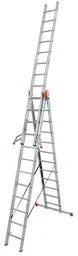
Multipurpose ladders
These are the all-rounders. Thanks to their folding design, they can be used as a step ladder, leaning ladder or even as a work platform. Three-section models such as the
or the offer maximum flexibility.
Folding scaffolds and folding trestles
Folding scaffolds such as the ROLLTEC model provide a quick, compact solution for medium heights. They are easy to assemble and take up little storage space. Folding trestles, such as the
, serve as a basic support structure. Combine them with sturdy boards to create a customised work platform.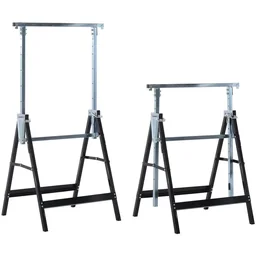
Tip: For occasional DIY work, a good multipurpose ladder is often the most sensible investment. It covers most jobs around the home and garden and is easy to transport.
How do I find the right model for my needs?
Ask yourself these three key questions before buying. They will guide you towards the best choice.
Question 1: What maximum height do I need to reach?
The required working height is the most important factor. Remember that the working height is approximately two metres above the standing height on the ladder. Reaching the gutters of detached houses often requires leaning ladders with 12 or more rungs. Compact step ladders are usually sufficient for indoor work.
Question 2: How stable and level is my ground?
A ladder is only as safe as the ground beneath it. On soft, uneven or slippery ground, scaffolding with adjustable supports or trestles is considerably safer. It distributes the weight and provides a level base.
Question 3: How long will I be using it?
A ladder is enough for quickly reaching a high shelf. However, if you need to cut, process or install materials for several hours, the comfortable, stable platform of scaffolding is hard to beat. It helps prevent fatigue and accidents.
Warning: Never combine different ladders or place a ladder on other objects to gain extra height. These setups can easily tip over and cause serious falls. Use suitable scaffolding instead.
Which safety aspects are absolutely critical?
Safety is the top priority. Ignoring these rules puts you at risk of serious injury.
Correct positioning
Set up leaning ladders at the correct angle: 1 metre from the wall for every 4 metres of ladder height. Secure the feet to prevent slipping. With step ladders, all spreaders must be fully extended and locked in place.
Observe the maximum load
Every ladder and scaffold has a permitted total load. This includes your weight plus the weight of tools and materials. Never exceed this limit. Professional models are considerably more robust in this respect.
Regular visual inspection
Before every use, check the load-bearing rungs, joints and feet for damage such as cracks, deformation or corrosion. Defective equipment must no longer be used.
How do the best products compare in 2026?
Our comparison helps you identify the strengths and ideal applications of the top models.
The highest-rated ladders and scaffolding in our range compared directly:
| Model | Customer rating | Availability |
|---|---|---|
| "ROLLTEC" FOLDING SCAFFOLD, AH 2,90M | – | Currently unavailable |
| "SEPURO PLUSLINE" STEP LADDER 2 STEPS | – | Currently unavailable |
| "TRIBILO" MULTIPURPOSE RUNG LADDER, THREE-SECTION 3x10 RUNGS | – | Currently unavailable |
| "TRIBILO" MULTIPURPOSE RUNG LADDER, THREE-SECTION 3x12 RUNGS | – | Currently unavailable |
| "TRIBILO" MULTIPURPOSE RUNG LADDER, THREE-SECTION 3x9 RUNGS | – | Currently unavailable |
The table clearly shows that three-section multipurpose ladders like the stand out for their unbeatable versatility. They are the first choice for anyone who wants just one piece of equipment for different tasks. For larger areas and longer jobs, scaffold trestles such as the form the basis of a safe solution.
Note: The availability of the models mentioned may vary. Our tools range is constantly updated, always offering you a wide selection of safe, tested ladders and scaffolding.
What are the most common buying mistakes?
Avoid these typical buying mistakes to prevent disappointment and uncertainty.
Underestimating the required height
Most people buy a ladder that is too short. Calculate the working height you need realistically and add a safety margin. It is better to have one extra rung than to have to work on tiptoe.
Ignoring weight and transport
A sturdy steel step ladder is very stable, but also extremely heavy. Consider whether you may need to move the equipment on your own. Aluminium models are often the better choice here.
Choosing the wrong material
Wooden ladders are inexpensive, but they can splinter and are heavy. Aluminium is lightweight and robust, but conducts electricity. For electrical work, insulated or glass-fibre-reinforced plastic (GRP) ladders are essential.
How can I prepare properly for working at height?
Good preparation is half the battle when it comes to working safely and successfully at height.
Pre-use checklist
- Check the equipment: Inspect it for damage and test that all joints function properly.
- Check the surface: Is it firm, level and dry? Use a support or mat if necessary.
- Check the weather: Do not use ladders or scaffolding in strong winds, rain or snow.
- Secure your tools: Use a tool belt or a tool tray. Never balance tools on the ladder.
- Wear suitable clothing: Wear sturdy footwear with a slip-resistant sole and avoid loose clothing that could get caught.
Safe behaviour on a ladder
Always keep one hand on the ladder. The “three-point contact” (two feet and one hand) should never be broken. Never lean out to the side. Climb down and reposition the ladder instead. Do not carry heavy loads up the ladder.
Conclusion: How to make the right choice
Choosing between a ladder and scaffolding is not a matter of chance, but of your specific requirements. For flexible, mobile jobs at moderate heights, high-quality multi-purpose ladders are hard to beat. They combine many functions in a single piece of equipment. For extensive, long-term projects where stability and a large standing area are important, scaffolding is the only safe choice.
Invest in quality and safety. Safe equipment is not an expense, but insurance. Follow the manufacturer's instructions, check your equipment regularly and always work carefully. This will help you tackle any challenge at height safely and efficiently.
Discover our extensive range of ladders and scaffolding now and find the right model for your next project.
Frequently asked questions
- When is a ladder the better choice, and when is scaffolding?
- A ladder is the better choice for short, mobile jobs with changing work locations, such as painting or reaching shelves. Scaffolding is preferable when you need to work for longer periods on a stable, spacious platform or transport heavy materials, for example when carrying out facade work.
- What does the maximum working height of a ladder mean?
- The maximum working height indicates how high you can work safely with your arms outstretched. It is considerably higher than the ladder height. If you are standing on the penultimate rung, you should not exceed this height. Always follow the manufacturer's instructions for your safety.
- Which safety standards are important for ladders and scaffolding?
- In Europe, the DIN EN 131 standard is decisive for ladders. It regulates their construction, stability and test procedures. DIN EN 12810 and 12811 are relevant for scaffolding. When buying, look for this CE marking. It guarantees that the product meets European safety requirements.
- Can I use a multi-purpose ladder as a substitute for scaffolding?
- Yes, many three-section multi-purpose ladders can be set up as a closed platform, similar to a small scaffold. This provides more standing space and stability than a leaning ladder. However, traditional scaffolding is indispensable for larger areas or extreme heights.
- What do I need to consider when assembling scaffolding?
- The surface must be level, load-bearing and compacted. Always use support blocks on uneven surfaces. Secure the scaffolding against tipping, especially when using facade scaffolding. Always install all guardrails and toe boards. Check its stability before use.