
In brief: Junction boxes connect and protect several cables at accessible points, while flush-mounted back boxes in walls house switches, sockets and connections. For home electrics, choose the box based on installation depth, number of cables and ingress protection rating. Work on live cables must be carried out by a qualified electrician; wiring sockets is not for untrained hands.
Quick answer: Junction boxes connect and protect several cables at accessible points, while flush-mounted back boxes in walls house switches, sockets and connections. For home electrics, choose the box based on installation depth, number of cables and ingress protection rating. Work on live cables must be carried out by a qualified electrician; wiring sockets is not for untrained hands.
A neat electrical installation begins long before the first box is installed. You plan cable routes, circuits, installation locations and future accessibility. Junction boxes and flush-mounted back boxes may look similarly unremarkable, but they serve different purposes and determine how safe, easy to maintain and tidy your home electrical installation remains.
How do junction boxes and flush-mounted back boxes differ?
The junction box houses connections between several cables. It protects terminals and wires from contact, dust and mechanical impact. Many models are mounted visibly on the wall, in utility rooms, garages, workshops or under a canopy. Other versions are installed in accessible cavities.
The flush-mounted back box, by contrast, is installed in a masonry wall or a drywall partition. It houses switches, sockets, dimmers, network modules or electronic inserts. Its opening is later flush with the plaster or wall lining.
Junction box: connections protected and accessible
A junction box is suitable when cables meet at one point and are permanently connected there. Examples include the incoming cable and several outgoing cables for lighting, the garage or individual rooms. The box must be positioned so that a qualified electrician can inspect and maintain the connections later.
A concealed box behind tiles, a permanently screwed-on cover or a bricked-up wall makes troubleshooting much more difficult. For connections that must remain accessible, plan an inspection access point. The cover must be removable without damaging the wall.
Flush-mounted back box: the basis for switches and sockets
Flush-mounted back boxes differ in diameter, depth, material and application. A shallow box is only sufficient when the wires, terminals and insert have enough room. With several cables or electronic components, a deep box provides considerably more working space.
The correct spacing between the boxes is also important for switch and socket combinations. Common combinations use a standardised centre-to-centre spacing. The boxes must be aligned precisely, otherwise the frames and covers will sit crooked later.
| Component | Typical use | What to look for |
|---|---|---|
| Junction box | Connecting and distributing cables | Size, ingress protection rating, accessibility |
| Flush-mounted back box | Housing switches, sockets and inserts | Installation depth, wall type, alignment |
| Consumer unit | Protecting and distributing circuits centrally | Planning, labelling, professional installation |
Pro tip
Allow some spare capacity in every box. A deep flush-mounted back box makes it easier to fit terminals and electronic components. For a junction box, choose the next suitable size up when several cables, cable entries and bend radii come together.
When do you need a junction box?
A junction box is used wherever one cable is distributed to several circuits or loads. In a detached house, this can be useful in the cellar, garage, utility room or outbuilding. Outdoor lighting with several outgoing cables can also be divided up neatly there.
In small living spaces, a combination of device boxes and suitable cable routing is often sufficient. The more outgoing cables meet, the faster a device box becomes too cramped. Cables must not be crushed, and terminals need sufficient space for a secure connection.
Where should the junction box be installed?
Mount the box in a dry, stable and easily accessible location. In a cellar, it should not be installed where condensation regularly forms. In a garage, it needs protection from impacts and vehicle parts. Outdoors, the enclosure, cover and cable entries must be suitable for the environment.
The ingress protection rating describes how well an enclosure is protected against solid foreign objects and water. An enclosure rated IP65 is dust-tight and protected against water jets. This does not mean that it is suitable for permanent immersion. The seals must be seated cleanly, and the cover must close completely.
Which size and ingress protection rating is right?
The required size depends on the number and diameter of the cables, the terminals and the bend radii required. Do not just count the wires already present. The cable entry, strain relief and space needed for inspection must also be taken into account.
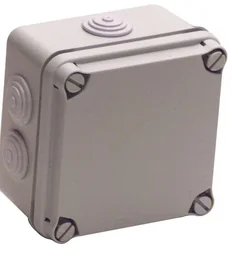
For straightforward connections, the with dimensions of 108 x 108 x 64 mm and an IP65 rating is suitable. When more cables or larger terminals come together, the with dimensions of 162 x 116 x 76 mm provides more interior space. Both models have grey enclosures and are designed for protected installation areas.
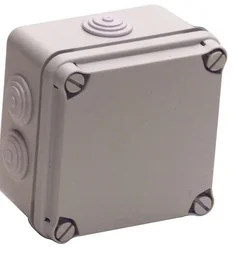
- : compact AP-FR junction box for smaller cable distributions.
- : larger AP-FR version for more cables and additional space inside the enclosure.
Keeping the installation area organised helps with later inspections. Suitable workshop and installation supplies can be found in the business supplies section. However, the junction box is no substitute for professional planning. The qualified electrician decides whether the enclosure, terminals and cables are electrically and mechanically compatible.
“The employer must ensure that electrical systems and equipment are installed, modified and maintained in accordance with the electrotechnical rules only by a qualified electrician or under the direction and supervision of a qualified electrician.”
How do you choose the right flush-mount back box?
The right flush-mount back box depends on the wall construction and the device being installed. For solid masonry, use a standard back box or a deep box designed to be set in plaster. For stud walls, use cavity wall back boxes with clamps or special fixing clips. A back box designed for a solid wall will not necessarily fit a plasterboard wall.
Standard back box or electronics back box?
A standard back box holds a switch or outlet. A deep back box provides more room for terminals and multiple wires. An electronics back box is useful when you also need space behind the switch or outlet for a relay, actuator, dimmer or smart control module.
Network, TV and multimedia outlets sometimes need more space than a standard outlet. Before installation, check the required installation depth for the specific outlet. The cover plate hides minor differences in dimensions, but it cannot fix a back box that is crooked or set too deep.
How deep should a flush-mount back box be?
The depth depends on the number of wires and the device being installed. A shallow back box takes up less space in the wall, but is harder to work in when there are several connections. A deep back box provides extra room and reduces the risk of wires being kinked or damaged when the device is fitted.
In a multi-gang installation, all back boxes must be level and aligned. Mark their positions before drilling or cutting into the wall. Allow for plaster thickness, tiles, wall coverings and the finished wall surface.
What should you consider when installing multiple outlets?
For two or more outlets, use suitable gang back boxes or connect individual boxes at the specified spacing. The cover plates determine the visible layout, not the electrical function. Each box needs to be securely fixed, have a suitable cable entry and provide enough room for the wires.
When renovating, it is worth checking the existing installation. Old cables, brittle insulation or unclear connections should not simply be put in a new back box. A qualified electrician can assess the condition of the existing circuit and determine whether any cables need to be replaced.
Important note
Never work on an installation just because the associated switch is turned off. A qualified electrician isolates the circuit, secures it against being switched back on and verifies that it is de-energized. Only then can anyone work on cables, terminals, back boxes or outlets.
How can you run cables neatly throughout your home?
If you are planning to run cables, start with a clear wiring plan. Mark circuits, junctions, switches, outlets and fixed appliances on the floor plan. Identify separate circuits and note which cable leads to each room or appliance. Clear documentation saves time later during repairs and alterations.
Planning cable routes in the wall
In living areas, cables should generally run in clearly identifiable horizontal or vertical wiring zones. Diagonal routes make future drilling more difficult and increase the risk of hitting a cable. Photograph cable routes before plastering and keep the plan with the test documentation.
Wall chases must not weaken the wall beyond what is permitted. Special requirements apply to load-bearing elements, prefabricated walls and reinforced concrete. The qualified electrician determines which cables can be installed in each area and whether conduit or other protective measures are needed.
Running and securing cables
Every cable needs a suitable entry point into a back box or junction box. Cable entries must not damage the insulation. For an outdoor junction box, suitable cable glands and seals protect against water and strain. Also pay attention to the cable's bend radius. A bend that is too tight puts strain on the wires and outer sheath.
Cables must not be left loose in cavities. They need to be routed securely and kept away from sharp edges. Suitable cable ties, clips or conduit are ideal for keeping cables neatly in place. Cable ties must not crush the insulation and are no substitute for proper cable supports.
Suitable power tools can be useful for drilling, installation and preparatory work. However, the tool alone does not turn a prepared cable into a complete electrical installation. A qualified electrician must make the connections, carry out the tests and put the installation into service.
What should you check before closing up the wall?
- Cable route: Every cable is clearly identified with its circuit and appliance.
- Back box: It is securely fixed, correctly aligned and provides enough space for the wires and accessory.
- Junction box: The cover, cable entry and seals are suitable for the environment.
- Documentation: Photos, sketches and labels are kept for future work.
- Protection: Cables are clear of sharp edges and protected against foreseeable stresses.
Label cables before closing up the wall. A small label on the junction box and an updated circuit diagram are more useful than guesswork years later. If there are several cables, use clear, consistent labels for the room, function and circuit.
“Cables and conductors must be selected and installed according to the external influences that can be expected.”
What should you consider when wiring and testing outlets?
Wiring an outlet may seem like a small job, but it is part of the permanent electrical system. A mistake involving the hot, neutral, or ground wire can damage appliances or put people at risk. A licensed electrician must make the connection, test the installation, and put it into service only after it has passed the required tests.
The five safety rules
The five safety rules apply before working on electrical installations. They establish safe working conditions and must be followed in the correct order:
- Disconnect: Switch off all poles of the applicable installation or circuit.
- Prevent reconnection: Secure switches or circuit breakers so they cannot be accidentally turned back on.
- Verify that the circuit is de-energized: A suitably qualified person tests the relevant conductors.
- Ground and short-circuit: Do this wherever required by the installation and working conditions.
- Cover or shield nearby live parts: This protects against hazards in adjacent areas.
For a typical home installation, the licensed electrician decides which measures are required for each specific job. A non-contact voltage tester is not a substitute for proper testing. Turning off a circuit breaker alone does not prove that the circuit is de-energized.
Which tests are required before putting the installation into service?
After wiring the outlet, the licensed electrician checks the grounding conductor, insulation resistance, conductor connections, loop or network impedance, and the operation of the ground-fault protection, where installed. The specific measurements depend on the installation, protective measures, and applicable electrical codes.
A ground-fault circuit interrupter (GFCI) can significantly improve safety on many circuits. It does not replace a properly installed grounding conductor or professional installation. Its trip function must be checked with suitable test equipment, not by performing an arbitrary test at the outlet.
How can you keep the installation easy to maintain?
Keep junction boxes accessible and label the circuits in the electrical panel clearly. Record changes on the wiring diagram and photograph concealed cable routes before closing the wall. When making alterations, the licensed electrician should check whether the existing wiring, circuit breakers, and protective measures are still suitable for the new use.
A neat finish means more than a straight cover plate. Wires should fit in the box without tension, terminals must be secure, the device must be firmly screwed in place, and the cover plate must fully cover the area around the wall opening. This keeps your home's electrical system organized and makes it easier to expand when needed.
Additional advice
Keep the circuit diagram, test report, and photos of concealed cable routes together. Add the date and the responsible electrical contractor. If you sell the property, renovate it, or need to troubleshoot a fault later, you can quickly see how the installation is laid out.
Junction boxes and electrical device boxes are small components with a big impact. A junction box provides space for protected, accessible connections. A flush-mount electrical box provides a stable base for switches, outlets, and modern electronic devices. If you choose the size, installation depth, IP rating, and cable route early, the electrical installation will be safer and easier to understand.
Frequently asked questions
- What is the difference between a junction box and a flush-mount electrical box?
- A junction box is usually visible or installed in an accessible cavity, where it brings several cables together. A flush-mount electrical box is installed in the wall and houses switches, outlets, or connections. A junction box provides more space for connections, while a flush-mount box gives devices and inserts a neat finish.
- When do I need a junction box?
- You need a junction box when several cables come together outside switch or outlet boxes, for example in a distribution area in the basement, garage, or outdoors. Choose the right size and IP rating. Connections must remain accessible and must not be left loose behind the wall.
- Which electrical box is suitable for an outlet?
- A deep single-gang box is often sufficient for one outlet, provided it has enough room for the wiring, terminals, and device. For multiple outlets, use combination or electrical device boxes. The wall construction, installation depth, box spacing, and number of conductors all matter. A licensed electrician should select and install the box.
- Can I install wiring and connect outlets myself?
- You may plan cable routes, prepare wall chases, and install boxes, provided the work is done safely and in accordance with applicable codes. Wiring, modifying, and testing the electrical installation must be left to a licensed electrician. They disconnect the power, prevent reconnection, take measurements, and document the completed installation.
- What IP rating does an outdoor junction box need?
- Outdoors, the required IP rating depends on exposure to rain, splashing water, dust, and the specific installation location. An IP65 junction box protects against dust and water jets when the cover, seals, and cable entries are fitted correctly. The licensed electrician must also assess UV exposure, condensation, mechanical stress, and the wiring being used.
You might also be interested in
- Electrical panel: Planning and installation at home
- Installing wall outlets: How to wire them safely
- Home electrical installation: Safe DIY tips for homeowners
- Electrical installation test & comparison 2026: The best products put to the test
- Safe electrical installation in a garden shed: Choosing the right wire connectors
- Installing electrical cables in the garden: Wiring, safety, and regulations